Quantum Machine Learning Demos
The following are some examples of quantum machine learning algorithms.
Application of Parameterized Quantum Circuit in Classification Task
1. QVC demo
This example uses VQNet to implement the algorithm in the thesis: Circuit-centric quantum classifiers . This example is used to determine whether a binary number is odd or even. By encoding the binary number onto the qubit and optimizing the variable parameters in the circuit, the z-direction observation of the circuit can indicate whether the input is odd or even.
Quantum circuit
The variable component sub-circuit usually defines a sub-circuit, which is a basic circuit architecture, and complex variational circuits can be constructed by repeating layers.
Our circuit layer consists of multiple rotating quantum logic gates and CNOT quantum logic gates that entangle each qubit with its neighboring qubits.
We also need a circuit to encode classical data into a quantum state, so that the output of the circuit measurement is related to the input.
In this example, we encode the binary input onto the qubits in the corresponding order. For example, the input data 1101 is encoded into 4 qubits.

import pyqpanda as pq

def qvc_circuits(input,weights,qlist,clist,machine):

    def get_cnot(nqubits):
        cir = pq.QCircuit()
        for i in range(len(nqubits)-1):
            cir.insert(pq.CNOT(nqubits[i],nqubits[i+1]))
        cir.insert(pq.CNOT(nqubits[len(nqubits)-1],nqubits[0]))
        return cir

    def build_circult(weights, xx, nqubits):

        def Rot(weights_j, qubits):
            circult = pq.QCircuit()
            circult.insert(pq.RZ(qubits, weights_j[0]))
            circult.insert(pq.RY(qubits, weights_j[1]))
            circult.insert(pq.RZ(qubits, weights_j[2]))
            return circult
        def basisstate():
            circult = pq.QCircuit()
            for i in range(len(nqubits)):
                if xx[i] == 1:
                    circult.insert(pq.X(nqubits[i]))
            return circult

        circult = pq.QCircuit()
        circult.insert(basisstate())

        for i in range(weights.shape[0]):

            weights_i = weights[i,:,:]
            for j in range(len(nqubits)):
                weights_j = weights_i[j]
                circult.insert(Rot(weights_j,nqubits[j]))
            cnots = get_cnot(nqubits)
            circult.insert(cnots)

        circult.insert(pq.Z(nqubits[0]))

        prog = pq.QProg()
        prog.insert(circult)
        return prog

    weights = weights.reshape([2,4,3])
    prog = build_circult(weights,input,qlist)
    prob = machine.prob_run_dict(prog, qlist[0], -1)
    prob = list(prob.values())

    return prob
Model building
We have defined variable quantum circuits qvc_circuits .
We hope to use it in our VQNet’s automatic differentiation framework,
to take advantage of VQNet’s optimization fucntions for model training.
We define a Model class, which inherits from the abstract class Module.
The model uses the QuantumLayer class, which is a quantum computing layer that can be automatically differentiated.
qvc_circuits is the quantum circuit we want to run,
24 is the number of all quantum circuit parameters that need to be trained,
“cpu” means that pyQPanda’s full amplitude simulator is used here,
and 4 means that 4 qubits need to be applied for.
In the forward() function, the user defines the logic of the model to run forward.
from pyvqnet.nn.module import Module
from pyvqnet.optim.sgd import SGD
from pyvqnet.nn.loss import CategoricalCrossEntropy
from pyvqnet.tensor.tensor import QTensor
import pyqpanda as pq
from pyvqnet.qnn.quantumlayer import QuantumLayer
from pyqpanda import *
class Model(Module):
    def __init__(self):
        super(Model, self).__init__()
        self.qvc = QuantumLayer(qvc_circuits,24,"cpu",4)

    def forward(self, x):
        return self.qvc(x)
Model training and testing
We use pre-generated random binary numbers and their odd and even labels. The data as follows.
import numpy as np
import os
qvc_train_data = [0,1,0,0,1,
0, 1, 0, 1, 0,
0, 1, 1, 0, 0,
0, 1, 1, 1, 1,
1, 0, 0, 0, 1,
1, 0, 0, 1, 0,
1, 0, 1, 0, 0,
1, 0, 1, 1, 1,
1, 1, 0, 0, 0,
1, 1, 0, 1, 1,
1, 1, 1, 0, 1,
1, 1, 1, 1, 0]
qvc_test_data= [0, 0, 0, 0, 0,
0, 0, 0, 1, 1,
0, 0, 1, 0, 1,
0, 0, 1, 1, 0]
def dataloader(data,label,batch_size, shuffle = True)->np:
    if shuffle:
        for _ in range(len(data)//batch_size):
            random_index = np.random.randint(0, len(data), (batch_size, 1))
            yield data[random_index].reshape(batch_size,-1),label[random_index].reshape(batch_size,-1)
    else:
        for i in range(0,len(data)-batch_size+1,batch_size):
            yield data[i:i+batch_size], label[i:i+batch_size]

def get_data(dataset_str):
    if dataset_str == "train":
        datasets = np.array(qvc_train_data)

    else:
        datasets = np.array(qvc_test_data)

    datasets = datasets.reshape([-1,5])
    data = datasets[:,:-1]
    label = datasets[:,-1].astype(int)
    label = np.eye(2)[label].reshape(-1,2)
    return data, label
Model forwarding, loss function calculation, reverse calculation, optimizer calculation can perform like the general neural network training mode,until the number of iterations reaches the preset value. The training data used is generated above, and the test data is qvc_test_data and train data is qvc_train_data.
def get_accuary(result,label):
    result,label = np.array(result.data), np.array(label.data)
    score = np.sum(np.argmax(result,axis=1)==np.argmax(label,1))
    return score

#Example Model Class
model = Model()
#Create a SGD  optimizer to optimize the model's parameters
optimizer = SGD(model.parameters(),lr =0.1)
#set batch_size = 3
batch_size = 3
#maximum epochs
epoch = 20
#model's loss function
loss = CategoricalCrossEntropy()

model.train()

datas,labels = get_data("train")

for i in range(epoch):
    count=0
    sum_loss = 0
    accuary = 0
    t = 0
    for data,label in dataloader(datas,labels,batch_size,False):
        optimizer.zero_grad()
        data,label = QTensor(data), QTensor(label)

        result = model(data)

        loss_b = loss(label,result)
        loss_b.backward()
        optimizer._step()
        sum_loss += loss_b.item()
        count+=batch_size
        accuary += get_accuary(result,label)
        t = t + 1

    print(f"epoch:{i}, #### loss:{sum_loss/count} #####accuray:{accuary/count}")


model.eval()
count = 0

test_data, test_label = get_data("test")
test_batch_size = 1
accuary = 0
sum_loss = 0
for testd,testl in dataloader(test_data,test_label,test_batch_size):
    testd = QTensor(testd)
    test_result = model(testd)
    test_loss = loss(testl,test_result)
    sum_loss += test_loss
    count+=test_batch_size
    accuary += get_accuary(test_result,testl)
print(f"test:--------------->loss:{sum_loss/count} #####accuray:{accuary/count}")
epoch:0, #### loss:0.20194714764753977 #####accuray:0.6666666666666666
epoch:1, #### loss:0.19724808633327484 #####accuray:0.8333333333333334
epoch:2, #### loss:0.19266503552595773 #####accuray:1.0
epoch:3, #### loss:0.18812804917494455 #####accuray:1.0
epoch:4, #### loss:0.1835678368806839 #####accuray:1.0
epoch:5, #### loss:0.1789149840672811 #####accuray:1.0
epoch:6, #### loss:0.17410411685705185 #####accuray:1.0
epoch:7, #### loss:0.16908332953850427 #####accuray:1.0
epoch:8, #### loss:0.16382796317338943 #####accuray:1.0
epoch:9, #### loss:0.15835540741682053 #####accuray:1.0
epoch:10, #### loss:0.15273457020521164 #####accuray:1.0
epoch:11, #### loss:0.14708336691061655 #####accuray:1.0
epoch:12, #### loss:0.14155150949954987 #####accuray:1.0
epoch:13, #### loss:0.1362930883963903 #####accuray:1.0
epoch:14, #### loss:0.1314386005202929 #####accuray:1.0
epoch:15, #### loss:0.12707658857107162 #####accuray:1.0
epoch:16, #### loss:0.123248390853405 #####accuray:1.0
epoch:17, #### loss:0.11995399743318558 #####accuray:1.0
epoch:18, #### loss:0.1171633576353391 #####accuray:1.0
epoch:19, #### loss:0.11482855677604675 #####accuray:1.0
[0.3412148654]
test:--------------->loss:QTensor(None, requires_grad=True) #####accuray:1.0
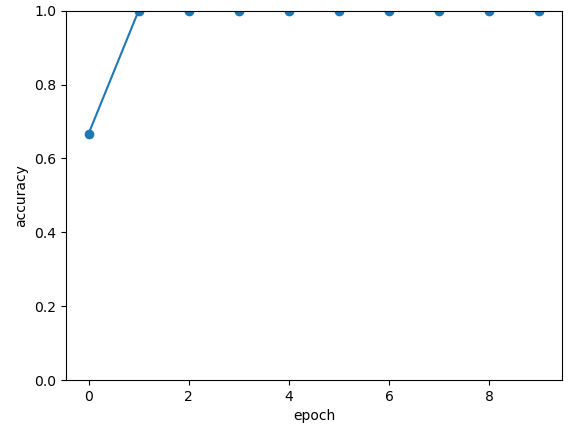
The following picture illustrates the curve of model’s accuracy:
2. data re-uploading algorithm
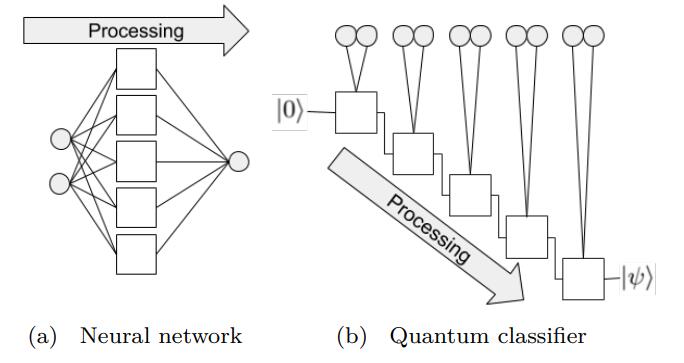
In a neural network, each neuron receives information from all neurons in the upper layer (Figure a). In contrast, the single-bit quantum classifier accepts the previous information processing unit and input (Figure b). For traditional quantum circuits, when the data is uploaded, the result can be obtained directly through several unitary transformations \(U(\theta_1,\theta_2,\theta_3)\).However, in the Quantum Data Re upLoading (QDRL) task, the data needs to be re-uploaded before every unitary transformation.
Comparison of QDRL and classic neural network schematics
"""
Parameterized quantum circuit for Quantum Data Re-upLoading
"""
import os
import sys
from pyvqnet.nn.linear import Linear
from pyvqnet.qnn.qdrl.vqnet_model import vmodel
from pyvqnet import _core as vcore
from pyvqnet.optim import sgd
from pyvqnet.nn import loss
from pyvqnet.nn.loss import CategoricalCrossEntropy
#hyperparameters
from pyvqnet.tensor.tensor import QTensor
from pyvqnet.tensor import tensor
import matplotlib
matplotlib.use('TkAgg')
import matplotlib.pyplot as plt
import numpy as np
np.random.seed(42)
from pyvqnet.nn.module import Module
num_layers =  3
params = np.random.uniform(size=(num_layers, 3))

#Create a Module to define the model
class Model(Module):

    def __init__(self):

        super(Model, self).__init__()
        self.pqc = vmodel(params.shape)
    def forward(self, x):
        x = self.pqc(x)
        return x

def circle(samples:int,  reps =  np.sqrt(1/2)) :
    data_x, data_y = [], []
    for i in range(samples):
        x = np.random.rand(2)
        y = [0,1]
        if np.linalg.norm(x) < reps:
            y = [1,0]
        data_x.append(x)
        data_y.append(y)
    return np.array(data_x), np.array(data_y)

def plot_data(x, y, fig=None, ax=None):
    """
    Plot data with red/blue values for a binary classification.

    Args:
        x (array[tuple]): array of data points as tuples
        y (array[int]): array of data points as tuples
    """
    if fig == None:
        fig, ax = plt.subplots(1, 1, figsize=(5, 5))
    reds = y == 0
    blues = y == 1
    ax.scatter(x[reds, 0], x[reds, 1], c="red", s=20, edgecolor="k")
    ax.scatter(x[blues, 0], x[blues, 1], c="blue", s=20, edgecolor="k")
    ax.set_xlabel("$x_1$")
    ax.set_ylabel("$x_2$")

def get_minibatch_data(x_data, label, batch_size):
    for i in range(0,x_data.data.shape[0]-batch_size+1,batch_size):
        yield x_data.data.select(["{}:{}".format(i,i+batch_size)]),
        label.data.select(["{}:{}".format(i,i+batch_size)]).reshape([batch_size,2])

def get_score(pred, label):
    pred, label = np.array(pred.data), np.array(label.data)
    score = np.sum(np.argmax(pred,axis=1) == np.argmax(label,1))
    return score

model = Model()
optimizer = sgd.SGD(model.parameters(),lr =1)

batch_size = 5
#train on random genearated samples
def train():
    model.train()
    x_train, y_train = circle(500)
    x_train = np.hstack((x_train, np.ones((x_train.shape[0], 1))))  # 500*3
    x_train, y_train = QTensor(x_train),QTensor(y_train)
    epoch = 10
    print("start training...........")
    for i in range(epoch):
        accuracy = 0
        count = 0
        loss = 0
        for data, label in get_minibatch_data(x_train, y_train,batch_size):
            optimizer.zero_grad()

            data,label = QTensor(data), QTensor(label)

            output = model(data)

            Closs = CategoricalCrossEntropy()
            losss = Closs(label, output)

            losss.backward()
            optimizer._step()

            accuracy += get_score(output,label)
            loss += losss.item()
            print(f"epoch:{i}, train_accuracy:{accuracy}")
            print(f"epoch:{i}, train_loss:{losss.data.getdata()}")
            count += batch_size

        print(f"epoch:{i}, train_accuracy_for_each_batch:{accuracy/count}")
        print(f"epoch:{i}, train_loss_for_each_batch:{loss/count}")

#test on random genearated samples
def test():
    model.eval()
    print("start eval...................")
    x_test, y_test = circle(500)
    test_accuracy = 0
    count = 0
    x_test = np.hstack((x_test, np.ones((x_test.shape[0], 1))))
    x_test, y_test = QTensor(x_test), QTensor(y_test)
    for test_data, test_label in get_minibatch_data(x_test,y_test, batch_size):

        test_data, test_label = QTensor(test_data),QTensor(test_label)
        output = model(test_data)
        test_accuracy += get_score(output, test_label)
        count += batch_size
    print(f"test_accuracy:{test_accuracy/count}")

if __name__=="__main__":
    train()
    test()
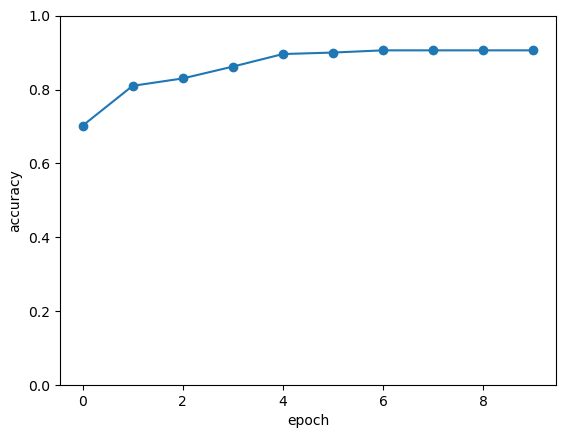
The following picture illustrates the curve of model’s accuracy:
3. VSQL: Variational Shadow Quantum Learning for Classification Model
Using variable quantum circuits to construct a two-class classification model, comparing the classification accuracy with a neural network with similar parameter accuracy, the accuracy of the two is similar. The quantity of parameters of quantum circuits is much smaller than that of classical neural networks. The algorithm is based on the paper: Variational Shadow Quantum Learning for Classification Model to reproduce.
Following figure shows the architecture of VSQL algorithm:

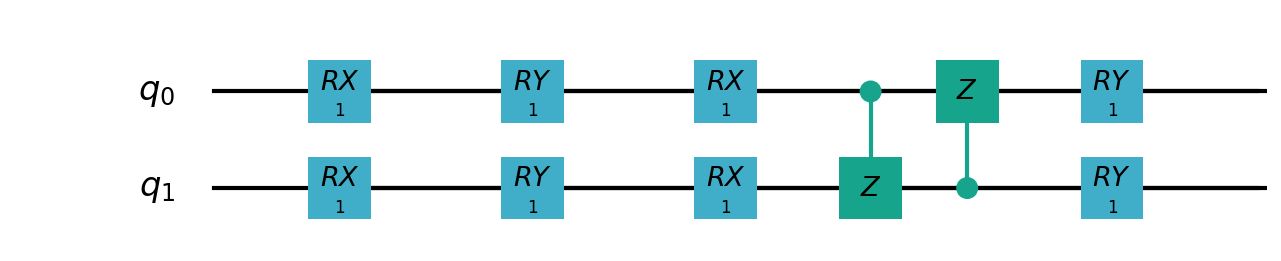
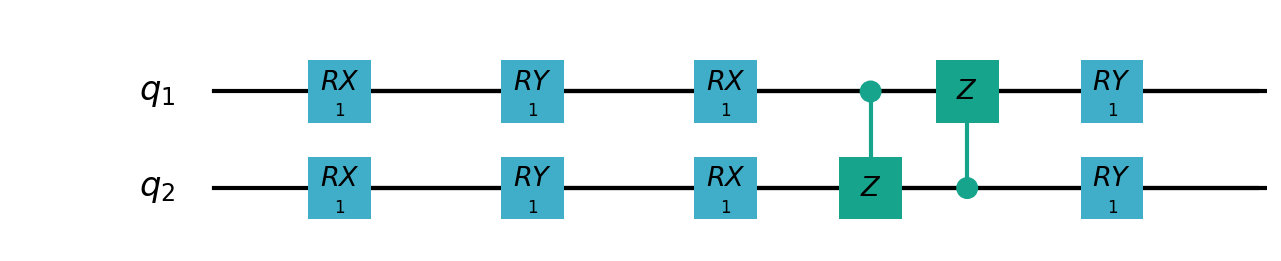
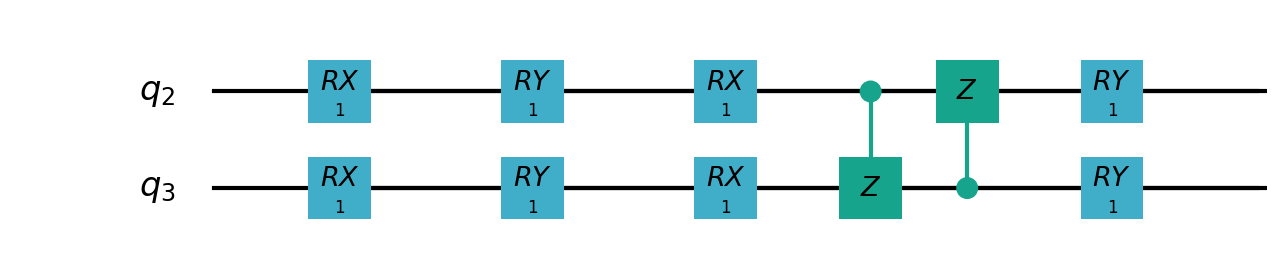
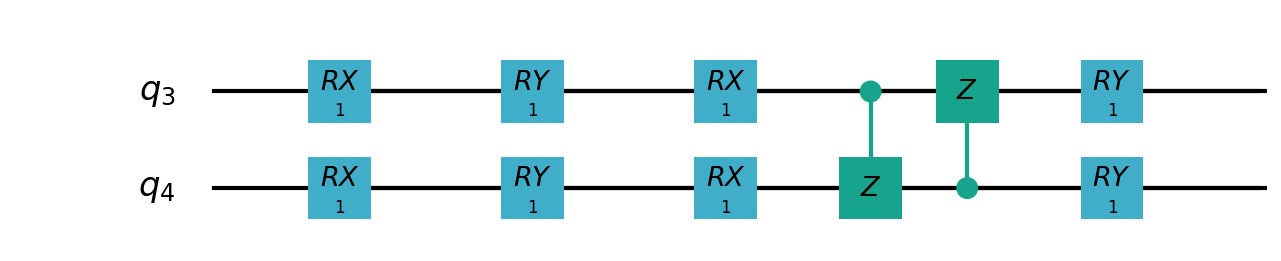
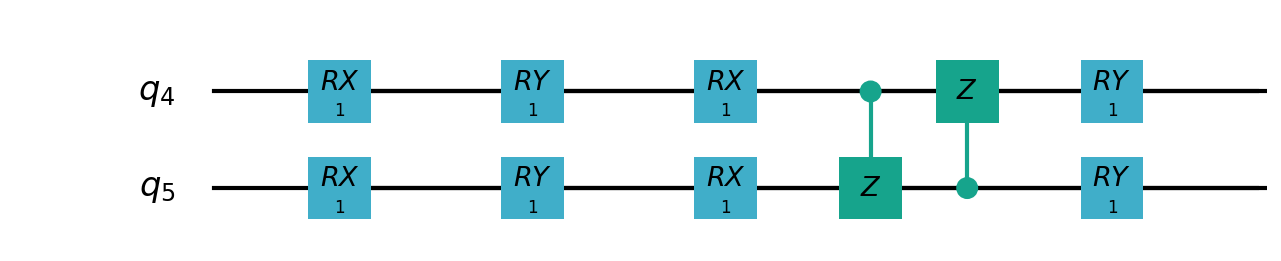
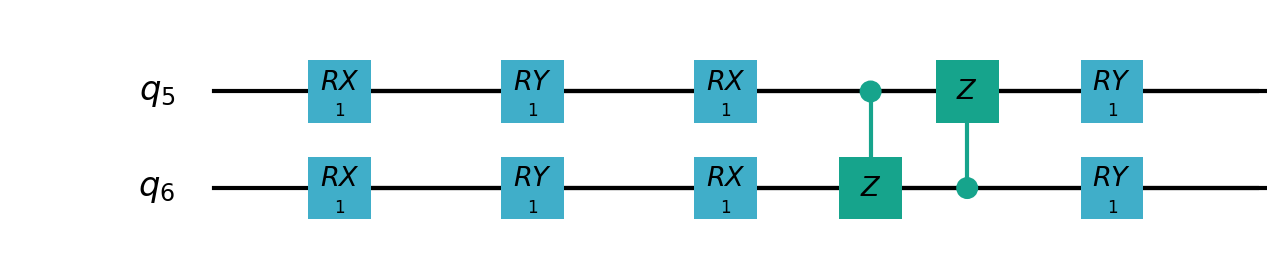
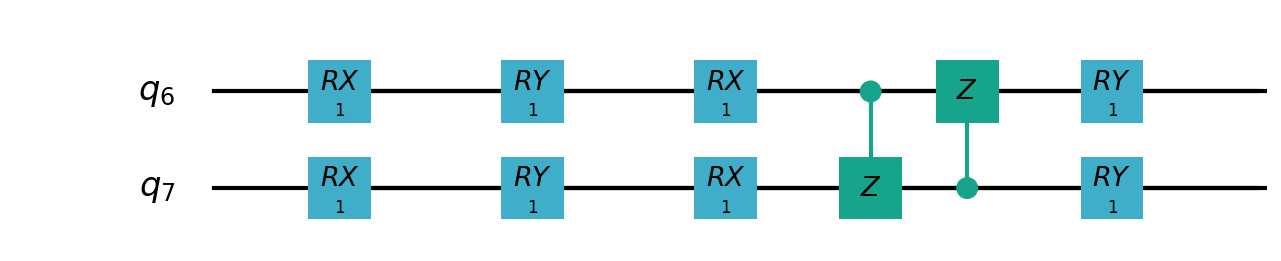
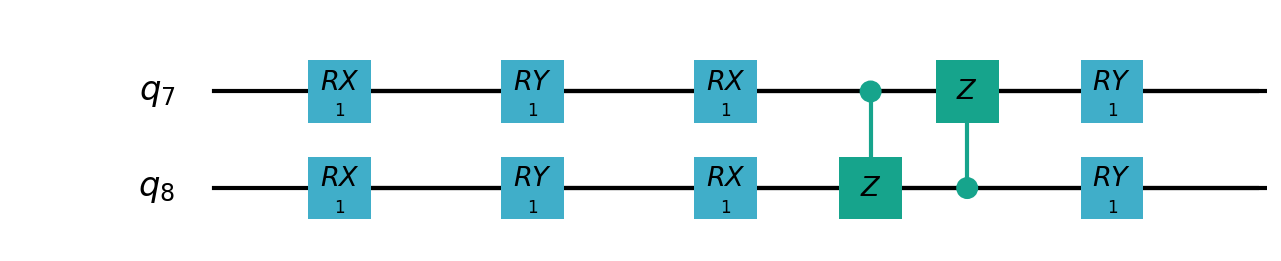
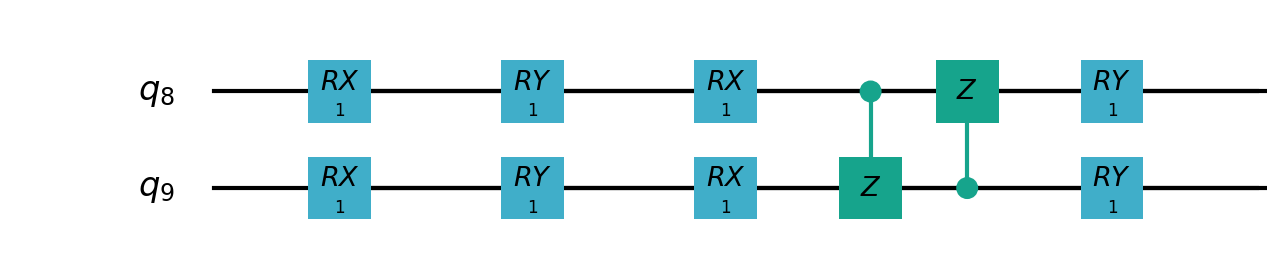
Following figures show the local quantum circuits structure on each qubits:
"""
Parameterized quantum circuit for VSQL

"""

import os
import sys
from pyvqnet.nn.module import Module
from pyvqnet.nn.loss import CategoricalCrossEntropy
from pyvqnet.optim.adam import Adam
from pyvqnet.data.data import data_generator
from pyvqnet.tensor import tensor
import numpy as np

import pyqpanda as pq
import matplotlib
try:
    matplotlib.use('TkAgg')
except:
    pass
import matplotlib.pyplot as plt

from pyvqnet.qnn.measure import expval
from pyvqnet.qnn.quantumlayer import QuantumLayer
from pyvqnet.qnn.template import AmplitudeEmbeddingCircuit
from pyvqnet.nn.linear import Linear

try:
    import urllib.request
except ImportError:
    raise ImportError('You should use Python 3.x')
import os.path
import gzip

url_base = 'http://yann.lecun.com/exdb/mnist/'
key_file = {
    'train_img':'train-images-idx3-ubyte.gz',
    'train_label':'train-labels-idx1-ubyte.gz',
    'test_img':'t10k-images-idx3-ubyte.gz',
    'test_label':'t10k-labels-idx1-ubyte.gz'
}


def _download(dataset_dir,file_name):
    file_path = dataset_dir + "/" + file_name

    if os.path.exists(file_path):
        with gzip.GzipFile(file_path) as f:
            file_path_ungz = file_path[:-3].replace('\\', '/')
            if not os.path.exists(file_path_ungz):
                open(file_path_ungz,"wb").write(f.read())
        return

    print("Downloading " + file_name + " ... ")
    urllib.request.urlretrieve(url_base + file_name, file_path)
    if os.path.exists(file_path):
            with gzip.GzipFile(file_path) as f:
                file_path_ungz = file_path[:-3].replace('\\', '/')
                file_path_ungz = file_path_ungz.replace('-idx', '.idx')
                if not os.path.exists(file_path_ungz):
                    open(file_path_ungz,"wb").write(f.read())
    print("Done")

def download_mnist(dataset_dir):
    for v in key_file.values():
        _download(dataset_dir,v)

if not os.path.exists("./result"):
    os.makedirs("./result")
else:
    pass

def circuits_of_vsql(input,weights,qlist,clist,machine):

    n = 10
    n_qsc=2
    depth=1
    weights = weights.reshape([depth + 1, 3, n_qsc])

    def subcir(weights,qlist,depth,n_qsc,n_start):
        cir = pq.QCircuit()

        for i in range(n_qsc):
            cir.insert(pq.RX(qlist[n_start + i],weights[0][0][i] ))
            cir.insert(pq.RY(qlist[n_start + i],weights[0][1][i]))
            cir.insert(pq.RX(qlist[n_start + i],weights[0][2][i]))
        for repeat in range(1, depth + 1):
            for i in range(n_qsc - 1):
                cir.insert(pq.CNOT(qlist[n_start + i], qlist[n_start + i + 1]))
            cir.insert(pq.CNOT(qlist[n_start + n_qsc - 1],qlist[ n_start]))
            for i in range(n_qsc):
                cir.insert(pq.RY(qlist[ n_start + i], weights[repeat][1][i]))

        return cir
    def get_pauli_str(n_start, n_qsc=2):
        pauli_str = ','.join('X' + str(i) for i in range(n_start, n_start + n_qsc))
        return {pauli_str:1.0}

    f_i = []

    for st in range(n - n_qsc + 1):
        psd = get_pauli_str(st,n_qsc)
        cir = pq.QCircuit()
        cir.insert(AmplitudeEmbeddingCircuit(input,qlist))
        cir.insert(subcir(weights,qlist,depth,n_qsc,st))
        prog = pq.QProg()
        prog.insert(cir)

        f_ij = expval(machine,prog,psd,qlist)
        f_i.append(f_ij)
    f_i = np.array(f_i)
    return f_i

#GLOBAL VAR
n = 10
n_qsc = 2
depth = 1
class QModel(Module):
    def __init__(self):
        super().__init__()
        self.vq = QuantumLayer(circuits_of_vsql,(depth + 1)*3* n_qsc,"cpu",10)
        self.fc = Linear(n - n_qsc + 1, 2)
    def forward(self, x):
        x = self.vq(x)
        x = self.fc(x)

        return x

class Model(Module):

    def __init__(self):
        super().__init__()
        self.fc1 = Linear(input_channels=28*28,output_channels=2)

    def forward(self, x):

        x = tensor.flatten(x,1)
        x = self.fc1(x)
        return x

def load_mnist(dataset="training_data", digits=np.arange(2), path="./"):
    import os, struct
    from array import array as pyarray
    download_mnist(path)
    if dataset == "training_data":
        fname_image = os.path.join(path, 'train-images.idx3-ubyte').replace('\\', '/')
        fname_label = os.path.join(path, 'train-labels.idx1-ubyte').replace('\\', '/')
    elif dataset == "testing_data":
        fname_image = os.path.join(path, 't10k-images.idx3-ubyte').replace('\\', '/')
        fname_label = os.path.join(path, 't10k-labels.idx1-ubyte').replace('\\', '/')
    else:
        raise ValueError("dataset must be 'training_data' or 'testing_data'")

    flbl = open(fname_label, 'rb')
    magic_nr, size = struct.unpack(">II", flbl.read(8))

    lbl = pyarray("b", flbl.read())
    flbl.close()

    fimg = open(fname_image, 'rb')
    magic_nr, size, rows, cols = struct.unpack(">IIII", fimg.read(16))
    img = pyarray("B", fimg.read())
    fimg.close()

    ind = [k for k in range(size) if lbl[k] in digits]
    N = len(ind)
    images = np.zeros((N, rows, cols))

    labels = np.zeros((N, 1), dtype=int)
    for i in range(len(ind)):
        images[i] = np.array(img[ind[i] * rows * cols: (ind[i] + 1) * rows * cols]).reshape((rows, cols))
        labels[i] = lbl[ind[i]]

    return images, labels

def show_image():
    image, label = load_mnist()
    for img in range(len(image)):
        plt.imshow(image[img])
        plt.show()

"""
compared classic fc model
"""
def run_fc01():

    digits = [0,1]
    x_train, y_train = load_mnist("training_data",digits)
    x_train = x_train / 255


    y_train = y_train.reshape(-1, 1)
    y_train = np.eye(len(digits))[y_train].reshape(-1, len(digits))

    x_test, y_test = load_mnist("testing_data",digits)
    x_test = x_test / 255
    y_test = y_test.reshape(-1, 1)
    y_test = np.eye(len(digits))[y_test].reshape(-1, len(digits))

    x_train = x_train[:500]
    y_train = y_train[:500]

    x_test = x_test[:100]
    y_test = y_test[:100]
    print("model start")
    model = Model()

    optimizer = Adam(model.parameters(),lr=0.01)

    model.train()
    F1 = open("./result/qfcrlt.txt","w")
    for epoch in range(1,20):

        model.train()
        full_loss = 0
        n_loss = 0
        n_eval =0
        batch_size = 128
        correct = 0
        iter = 0
        for x, y in data_generator(x_train, y_train, batch_size=batch_size, shuffle=True):#shuffle batch rather than data

            optimizer.zero_grad()
            try:
                x = x.reshape(batch_size, 1, 28, 28)
            except:
                x = x.reshape(-1,1,28,28)

            output = model(x)
            iter +=1

            CCEloss = CategoricalCrossEntropy()
            loss = CCEloss( y,output)
            loss.backward()
            optimizer._step()

            full_loss += loss.item()
            n_loss += batch_size
            np_output = np.array(output.data,copy=False)
            mask  = np_output.argmax(1) == y.argmax(1)
            correct += sum(mask)

        print(f"Train Accuracy: {correct/n_loss}%")
        print(f"Epoch: {epoch}, Loss: {full_loss / n_loss}")
        F1.write(f"{epoch}\t{full_loss / n_loss:.4f}\t{correct/n_loss:.4f}\t")

    # Evaluation
        model.eval()
        print("eval")
        correct = 0
        full_loss = 0
        n_loss = 0
        n_eval = 0
        batch_size = 1
        for x, y in data_generator(x_test, y_test, batch_size=batch_size, shuffle=True):
            x = x.reshape(1, 1, 28, 28)
            output = model(x)

            CCEloss = CategoricalCrossEntropy()
            loss = CCEloss( y,output)
            full_loss += loss.item()
            np_output = np.array(output.data,copy=False)
            mask  = np_output.argmax(1) == y.argmax(1)
            correct += sum(mask)
            n_eval += 1
            n_loss += 1

        print(f"Eval Accuracy: {correct/n_eval}")
        F1.write(f"{full_loss / n_loss:.4f}\t{correct/n_eval:.4f}\n")

    F1.close()
    del model
    print("\ndone\n")

"""
VQSL MODEL
"""
def run_VSQL():
    digits = [0,1]
    x_train, y_train = load_mnist("training_data",digits)
    x_train = x_train / 255
    y_train = y_train.reshape(-1, 1)
    y_train = np.eye(len(digits))[y_train].reshape(-1, len(digits))
    x_test, y_test = load_mnist("testing_data",digits)
    x_test = x_test / 255
    y_test = y_test.reshape(-1, 1)
    y_test = np.eye(len(digits))[y_test].reshape(-1, len(digits))

    x_train_list =[]
    x_test_list = []
    for i in range(x_train.shape[0]):
        x_train_list.append(np.pad(x_train[i,:,:].flatten(),(0, 240), constant_values=(0, 0)))
    x_train = np.array(x_train_list)

    for i in range(x_test.shape[0]):
        x_test_list.append(np.pad(x_test[i,:,:].flatten(),(0, 240), constant_values=(0, 0)))

    x_test = np.array(x_test_list)

    x_train = x_train[:500]
    y_train = y_train[:500]

    x_test = x_test[:100]
    y_test = y_test[:100]
    print("model start")
    model = QModel()

    optimizer = Adam(model.parameters(),lr=0.1)

    model.train()
    F1 = open("./result/vqslrlt.txt","w")
    for epoch in range(1,20):

        model.train()
        full_loss = 0
        n_loss = 0
        n_eval =0
        batch_size = 1
        correct = 0
        iter = 0
        for x, y in data_generator(x_train, y_train, batch_size=batch_size, shuffle=True):
            optimizer.zero_grad()
            try:
                x = x.reshape(batch_size, 1024)
            except:
                x = x.reshape(-1,1024)

            output = model(x)
            iter +=1

            CCEloss = CategoricalCrossEntropy()
            loss = CCEloss( y,output)
            loss.backward()
            optimizer._step()

            full_loss += loss.item()
            n_loss += batch_size
            np_output = np.array(output.data,copy=False)
            mask  = np_output.argmax(1) == y.argmax(1)
            correct += sum(mask)
            print(f"{iter}")
        print(f"Train Accuracy: {correct/n_loss}%")
        print(f"Epoch: {epoch}, Loss: {full_loss / n_loss}")
        F1.write(f"{epoch}\t{full_loss / n_loss}\t{correct/n_loss}\t")

    # Evaluation
        model.eval()
        print("eval")
        correct = 0
        full_loss = 0
        n_loss = 0
        n_eval = 0
        batch_size = 1
        for x, y in data_generator(x_test, y_test, batch_size=batch_size, shuffle=True):
            x = x.reshape(1, 1024)
            output = model(x)

            CCEloss = CategoricalCrossEntropy()
            loss = CCEloss( y,output)
            full_loss += loss.item()

            np_output = np.array(output.data,copy=False)
            mask  = np_output.argmax(1) == y.argmax(1)
            correct += sum(mask)
            n_eval += 1
            n_loss += 1

        print(f"Eval Accuracy: {correct/n_eval}")
        F1.write(f"{full_loss / n_loss}\t{correct/n_eval}\n")


    F1.close()
    del model
    print("\ndone vqsl\n")


if __name__ == '__main__':

    run_VSQL()
The following shows the curve of model’s accuacy and loss:


Quantum AutoEncoder Demo
1.Quantum AutoEncoder
The classic autoencoder is a neural network that can learn high-efficiency low-dimensional representations of data in a high-dimensional space. The task of the autoencoder is to map x to a low-dimensional point y given an input x, so that x can be recovered from y. The structure of the underlying autoencoder network can be selected to represent the data in a smaller dimension, thereby effectively compressing the input. Inspired by this idea, the model of quantum autoencoder is used to perform similar tasks on quantum data. Quantum autoencoders are trained to compress specific data sets of quantum states, and classical compression algorithms cannot be used. The parameters of the quantum autoencoder are trained using classical optimization algorithms. We show an example of a simple programmable circuit, which can be trained as an efficient autoencoder. We apply our model in the context of quantum simulation to compress the Hubbard model and the ground state of the Hamiltonian. This algorithm is based on Quantum autoencoders for efficient compression of quantum data .
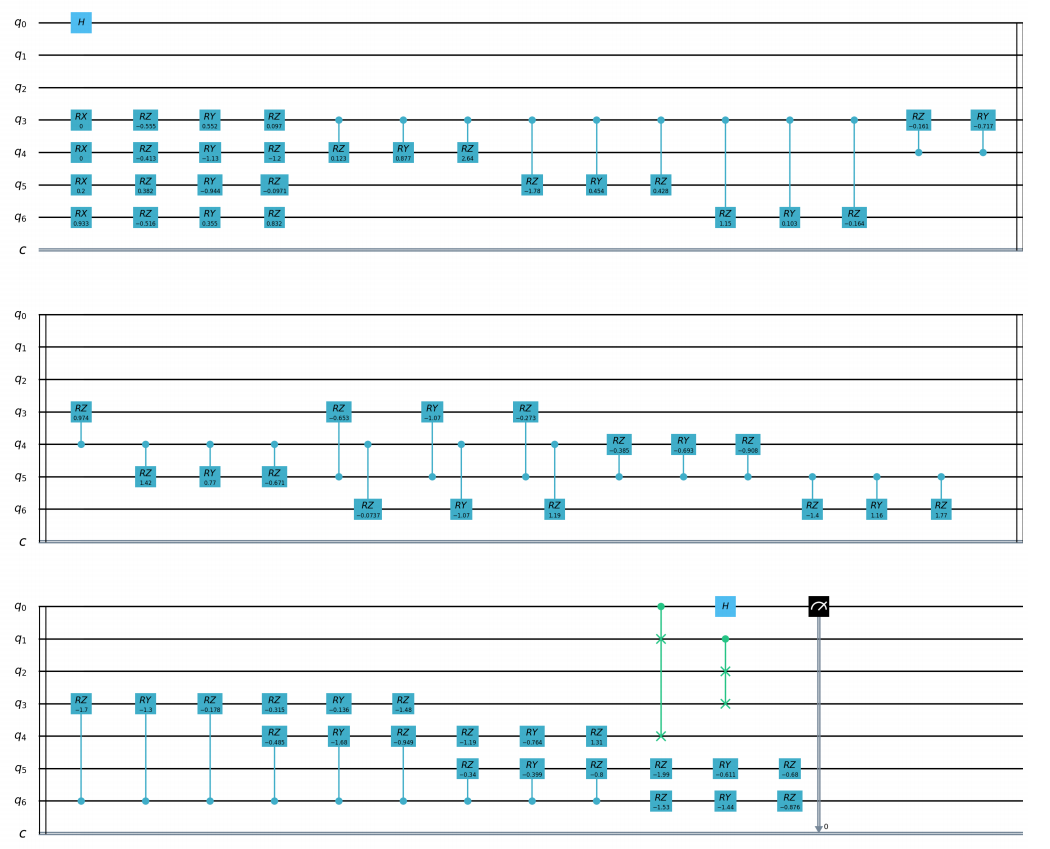
QAE quantum circuits:
"""
Quantum AutoEncoder demo

"""

import os
import sys
sys.path.insert(0,'../')
import numpy as np
from pyvqnet.nn.module import Module
from pyvqnet.nn.loss import  fidelityLoss
from pyvqnet.optim.adam import Adam
from pyvqnet.data.data import data_generator
from pyvqnet.qnn.qae.qae import QAElayer
import matplotlib.pyplot as plt
import matplotlib
try:
    matplotlib.use('TkAgg')
except:
    pass
try:
    import urllib.request
except ImportError:
    raise ImportError('You should use Python 3.x')
import os.path
import gzip

url_base = 'http://yann.lecun.com/exdb/mnist/'
key_file = {
    'train_img':'train-images-idx3-ubyte.gz',
    'train_label':'train-labels-idx1-ubyte.gz',
    'test_img':'t10k-images-idx3-ubyte.gz',
    'test_label':'t10k-labels-idx1-ubyte.gz'
}

def _download(dataset_dir,file_name):
    file_path = dataset_dir + "/" + file_name

    if os.path.exists(file_path):
        with gzip.GzipFile(file_path) as f:
            file_path_ungz = file_path[:-3].replace('\\', '/')
            if not os.path.exists(file_path_ungz):
                open(file_path_ungz,"wb").write(f.read())
        return

    print("Downloading " + file_name + " ... ")
    urllib.request.urlretrieve(url_base + file_name, file_path)
    if os.path.exists(file_path):
            with gzip.GzipFile(file_path) as f:
                file_path_ungz = file_path[:-3].replace('\\', '/')
                file_path_ungz = file_path_ungz.replace('-idx', '.idx')
                if not os.path.exists(file_path_ungz):
                    open(file_path_ungz,"wb").write(f.read())
    print("Done")

def download_mnist(dataset_dir):
    for v in key_file.values():
        _download(dataset_dir,v)


class Model(Module):

    def __init__(self, trash_num: int = 2, total_num: int = 7):
        super().__init__()
        self.pqc = QAElayer(trash_num, total_num)

    def forward(self, x):

        x = self.pqc(x)
        return x

def load_mnist(dataset="training_data", digits=np.arange(2), path="./"):
    import os, struct
    from array import array as pyarray
    download_mnist(path)
    if dataset == "training_data":
        fname_image = os.path.join(path, 'train-images.idx3-ubyte').replace('\\', '/')
        fname_label = os.path.join(path, 'train-labels.idx1-ubyte').replace('\\', '/')
    elif dataset == "testing_data":
        fname_image = os.path.join(path, 't10k-images.idx3-ubyte').replace('\\', '/')
        fname_label = os.path.join(path, 't10k-labels.idx1-ubyte').replace('\\', '/')
    else:
        raise ValueError("dataset must be 'training_data' or 'testing_data'")

    flbl = open(fname_label, 'rb')
    magic_nr, size = struct.unpack(">II", flbl.read(8))

    lbl = pyarray("b", flbl.read())
    flbl.close()

    fimg = open(fname_image, 'rb')
    magic_nr, size, rows, cols = struct.unpack(">IIII", fimg.read(16))
    img = pyarray("B", fimg.read())
    fimg.close()

    ind = [k for k in range(size) if lbl[k] in digits]
    N = len(ind)
    images = np.zeros((N, rows, cols))
    labels = np.zeros((N, 1), dtype=int)
    for i in range(len(ind)):
        images[i] = np.array(img[ind[i] * rows * cols: (ind[i] + 1) * rows * cols]).reshape((rows, cols))
        labels[i] = lbl[ind[i]]

    return images, labels

def run2():
    ##load dataset

    x_train, y_train = load_mnist("training_data")
    x_train = x_train / 255

    x_test, y_test = load_mnist("testing_data")

    x_test = x_test / 255

    x_train = x_train.reshape([-1, 1, 28, 28])
    x_test = x_test.reshape([-1, 1, 28, 28])
    x_train = x_train[:100, :, :, :]
    x_train = np.resize(x_train, [x_train.shape[0], 1, 2, 2])

    x_test = x_test[:10, :, :, :]
    x_test = np.resize(x_test, [x_test.shape[0], 1, 2, 2])
    encode_qubits = 4
    latent_qubits = 2
    trash_qubits = encode_qubits - latent_qubits
    total_qubits = 1 + trash_qubits + encode_qubits
    print("model start")
    model = Model(trash_qubits, total_qubits)

    optimizer = Adam(model.parameters(), lr=0.005)
    model.train()
    F1 = open("rlt.txt", "w")
    loss_list = []
    loss_list_test = []
    fidelity_train = []
    fidelity_val = []

    for epoch in range(1, 10):
        running_fidelity_train = 0
        running_fidelity_val = 0
        print(f"epoch {epoch}")
        model.train()
        full_loss = 0
        n_loss = 0
        n_eval = 0
        batch_size = 1
        correct = 0
        iter = 0
        if epoch %5 ==1:
            optimizer.lr  = optimizer.lr *0.5
        for x, y in data_generator(x_train, y_train, batch_size=batch_size, shuffle=True): #shuffle batch rather than data

            x = x.reshape((-1, encode_qubits))
            x = np.concatenate((np.zeros([batch_size, 1 + trash_qubits]), x), 1)
            optimizer.zero_grad()
            output = model(x)
            iter += 1
            np_out = np.array(output.data)
            floss = fidelityLoss()
            loss = floss(output)
            loss_data = np.array(loss.data)
            loss.backward()

            running_fidelity_train += np_out[0]
            optimizer._step()
            full_loss += loss_data[0]
            n_loss += batch_size
            np_output = np.array(output.data, copy=False)
            mask = np_output.argmax(1) == y.argmax(1)

            correct += sum(mask)

        loss_output = full_loss / n_loss
        print(f"Epoch: {epoch}, Loss: {loss_output}")
        loss_list.append(loss_output)

        # F1.write(f"{epoch}\t{full_loss / n_loss}\t{correct/n_loss}\t")

        # Evaluation
        model.eval()
        correct = 0
        full_loss = 0
        n_loss = 0
        n_eval = 0
        batch_size = 1
        for x, y in data_generator(x_test, y_test, batch_size=batch_size, shuffle=True):
            x = x.reshape((-1, encode_qubits))
            x = np.concatenate((np.zeros([batch_size, 1 + trash_qubits]),x),1)
            output = model(x)

            floss = fidelityLoss()
            loss = floss(output)
            loss_data = np.array(loss.data)
            full_loss += loss_data[0]
            running_fidelity_val += np.array(output.data)[0]

            n_eval += 1
            n_loss += 1

        loss_output = full_loss / n_loss
        print(f"Epoch: {epoch}, Loss: {loss_output}")
        loss_list_test.append(loss_output)

        fidelity_train.append(running_fidelity_train / 64)
        fidelity_val.append(running_fidelity_val / 64)

    figure_path = os.path.join(os.getcwd(), 'QAE-rate1.png')
    plt.plot(loss_list, color="blue", label="train")
    plt.plot(loss_list_test, color="red", label="validation")
    plt.title('QAE')
    plt.xlabel("Epochs")
    plt.ylabel("Loss")
    plt.legend(loc="upper right")
    plt.savefig(figure_path)
    plt.show()

    F1.write(f"done\n")
    F1.close()
    del model

if __name__ == '__main__':
    run2()
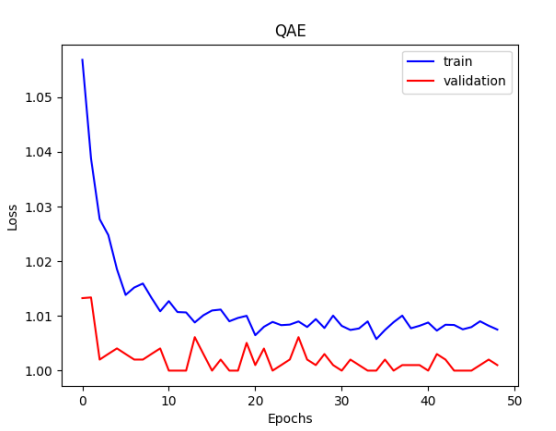
The QAE error value obtained by running the above code, the loss is 1/fidelity, tending to 1 means the fidelity is close to 1.
Quantum Circuits Structure Learning Demo
1.Quantum circuits structure learning
In the quantum circuit structure, the most frequently used quantum gates with parameters are RZ , RY , and RX gates, but which gate to use under what circumstances is a question worth studying. One method is random selection, but in this case It is very likely that the best results will not be achieved. The core goal of Quantum circuit structure learning task is to find the optimal combination of quantum gates with parameters. The approach here is that this set of optimal quantum logic gates should make the loss function to be the minimum.
"""
Quantum Circuits Strcture Learning Demo

"""

import os
import sys

import pyqpanda as pq
from pyvqnet.tensor.tensor import QTensor
from pyvqnet.nn.module import Module
import numpy as np
from pyvqnet._core import Tensor as CoreTensor
import copy
from pyvqnet.qnn.measure import expval
machine = pq.CPUQVM()
machine.init_qvm()
nqbits = machine.qAlloc_many(2)

#genearate candidate quantum gates
def gen(param:CoreTensor,generators,qbits,circuit):
    if generators == "X":
        circuit.insert(pq.RX(qbits,param))
    elif generators =="Y":
        circuit.insert(pq.RY(qbits,param))
    else:
        circuit.insert(pq.RZ(qbits,param))

#generate circuits based on candidate quantum gates
def circuits(params,generators,circuit):
    gen(params[0], generators[0], nqbits[0], circuit)
    gen(params[1], generators[1], nqbits[1], circuit)
    circuit.insert(pq.CNOT(nqbits[0], nqbits[1]))
    prog = pq.QProg()
    prog.insert(circuit)
    return prog

def ansatz1(params:QTensor,generators):
    circuit = pq.QCircuit()
    params = params.data.getdata()
    prog = circuits(params,generators,circuit)
    return expval(machine,prog,{"Z0":1},nqbits), expval(machine,prog,{"Y1":1},nqbits)

def ansatz2(params:QTensor,generators):
    circuit = pq.QCircuit()
    params = params.data.getdata()
    prog = circuits(params, generators, circuit)
    return expval(machine,prog,{"X0":1},nqbits)

#target loss function
def loss(params,generators):
    Z, Y = ansatz1(params,generators)
    X = ansatz2(params,generators)
    return 0.5 * Y + 0.8 * Z - 0.2 * X

#rotosolve algorithm to find optimal parameter
def rotosolve(d, params, generators, cost, M_0):  # M_0 only calculated once
    params[d] = np.pi / 2.0
    M_0_plus = cost(QTensor(params), generators)
    params[d] = -np.pi / 2.0
    M_0_minus = cost(QTensor(params), generators)
    a = np.arctan2(
        2.0 * M_0 - M_0_plus - M_0_minus, M_0_plus - M_0_minus
    )  # returns value in (-pi,pi]
    params[d] = -np.pi / 2.0 - a
    if params[d] <= -np.pi:
        params[d] += 2 * np.pi
    return cost(QTensor(params), generators)

#rotoselect algorithm to find best circuits structure
def optimal_theta_and_gen_helper(index,params,generators):
    params[index] = 0.
    M_0 = loss(QTensor(params),generators)#init value
    for kind in ["X","Y","Z"]:
        generators[index] = kind
        params_cost = rotosolve(index, params, generators, loss, M_0)
        if kind == "X" or params_cost <= params_opt_cost:
            params_opt_d = params[index]
            params_opt_cost = params_cost
            generators_opt_d = kind
    return params_opt_d, generators_opt_d

def rotoselect_cycle(params:np,generators):
    for index in range(params.shape[0]):
        params[index], generators[index] = optimal_theta_and_gen_helper(index,params,generators)
    return params,generators


params = QTensor(np.array([0.3,0.25]))
params = params.data.getdata()
generator = ["X","Y"]
generators = copy.deepcopy(generator)
epoch = 20
state_save = []
for i in range(epoch):
    state_save.append(loss(QTensor(params), generators))
    params, generators = rotoselect_cycle(params,generators)

print("Optimal generators are: {}".format(generators))
steps = np.arange(0, epoch)

import matplotlib
matplotlib.use('TkAgg')
import matplotlib.pyplot as plt

plt.plot(steps, state_save, "o-")
plt.title("rotoselect")
plt.xlabel("cycles")
plt.ylabel("cost")
plt.yticks(np.arange(-1.25, 0.80, 0.25))
plt.tight_layout()
plt.show()
The quantum circuit structure obtained by running the above code contains \(RX\), one \(RY\)
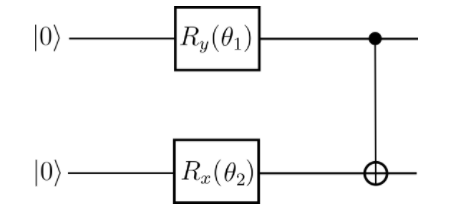
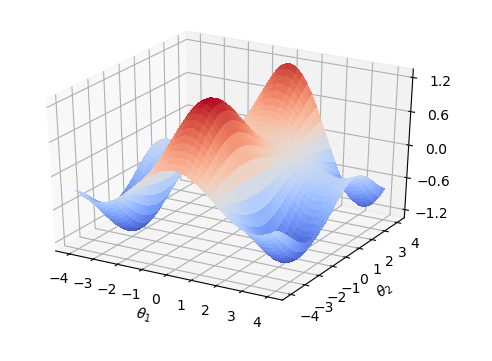
And with the parameters in the quantum gate \(\theta_1\), \(\theta_2\) change,Loss function has different values.
Hybird Quantum Classic Nerual Network Demo
1.Hybrid Quantum Classic Neural Network Model
Machine learning (ML) has become a successful interdisciplinary field that aims to extract generalizable information from data mathematically. Quantum machine learning seeks to use the principles of quantum mechanics to enhance machine learning, and vice versa. Whether your goal is to enhance classical ML algorithms by outsourcing difficult calculations to quantum computers, or use classical ML architectures to optimize quantum algorithms-both fall into the category of quantum machine learning (QML). In this chapter, we will explore how to partially quantify classical neural networks to create hybrid quantum classical neural networks. Quantum circuits are composed of quantum logic gates, and the quantum calculations implemented by these logic gates are proved to be differentiable by the paper Quantum Circuit Learning. Therefore, researchers try to put quantum circuits and classical neural network modules together for training on hybrid quantum classical machine learning tasks. We will write a simple example to implement a neural network model training task using VQNet. The purpose of this example is to demonstrate the simplicity of VQNet and encourage ML practitioners to explore the possibilities of quantum computing.
Data Preparation
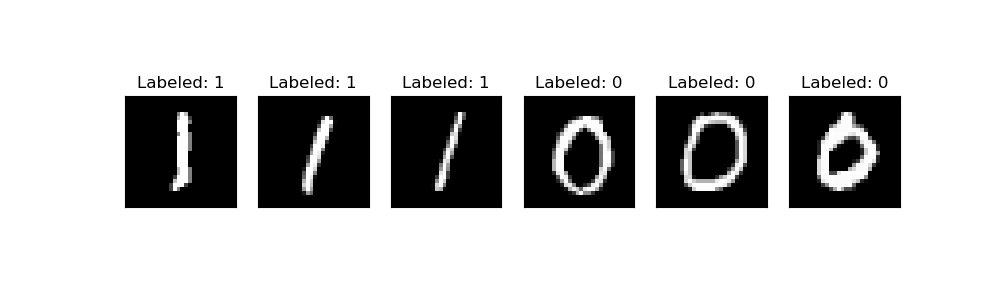
We will use MNIST datasets, the most basic neural network handwritten digit database as the classification data. We first load MNIST and filter data samples containing 0 and 1. These samples are divided into training data training_data and testing data testing_data, each of which has a dimension of 1*784.
import time
import os
import struct
import gzip
from pyvqnet.nn.module import Module
from pyvqnet.nn.linear import Linear
from pyvqnet.nn.conv import Conv2D

from pyvqnet.nn import activation as F
from pyvqnet.nn.pooling import MaxPool2D
from pyvqnet.nn.loss import CategoricalCrossEntropy
from pyvqnet.optim.adam import Adam
from pyvqnet.data.data import data_generator
from pyvqnet.tensor import tensor
from pyvqnet.tensor import QTensor
import pyqpanda as pq

import numpy as np
import matplotlib.pyplot as plt
import matplotlib
try:
    matplotlib.use("TkAgg")
except:  #pylint:disable=bare-except
    print("Can not use matplot TkAgg")
    pass

try:
    import urllib.request
except ImportError:
    raise ImportError("You should use Python 3.x")

url_base = "http://yann.lecun.com/exdb/mnist/"
key_file = {
    "train_img": "train-images-idx3-ubyte.gz",
    "train_label": "train-labels-idx1-ubyte.gz",
    "test_img": "t10k-images-idx3-ubyte.gz",
    "test_label": "t10k-labels-idx1-ubyte.gz"
}

def _download(dataset_dir, file_name):
    """
    Download mnist data if needed.
    """
    file_path = dataset_dir + "/" + file_name

    if os.path.exists(file_path):
        with gzip.GzipFile(file_path) as file:
            file_path_ungz = file_path[:-3].replace("\\", "/")
            if not os.path.exists(file_path_ungz):
                open(file_path_ungz, "wb").write(file.read())
        return

    print("Downloading " + file_name + " ... ")
    urllib.request.urlretrieve(url_base + file_name, file_path)
    if os.path.exists(file_path):
        with gzip.GzipFile(file_path) as file:
            file_path_ungz = file_path[:-3].replace("\\", "/")
            file_path_ungz = file_path_ungz.replace("-idx", ".idx")
            if not os.path.exists(file_path_ungz):
                open(file_path_ungz, "wb").write(file.read())
    print("Done")

def download_mnist(dataset_dir):
    for v in key_file.values():
        _download(dataset_dir, v)

def load_mnist(dataset="training_data", digits=np.arange(2), path="./"):
    """
    load mnist data
    """
    from array import array as pyarray
    download_mnist(path)
    if dataset == "training_data":
        fname_image = os.path.join(path, "train-images.idx3-ubyte").replace(
            "\\", "/")
        fname_label = os.path.join(path, "train-labels.idx1-ubyte").replace(
            "\\", "/")
    elif dataset == "testing_data":
        fname_image = os.path.join(path, "t10k-images.idx3-ubyte").replace(
            "\\", "/")
        fname_label = os.path.join(path, "t10k-labels.idx1-ubyte").replace(
            "\\", "/")
    else:
        raise ValueError("dataset must be 'training_data' or 'testing_data'")

    flbl = open(fname_label, "rb")
    _, size = struct.unpack(">II", flbl.read(8))
    lbl = pyarray("b", flbl.read())
    flbl.close()

    fimg = open(fname_image, "rb")
    _, size, rows, cols = struct.unpack(">IIII", fimg.read(16))
    img = pyarray("B", fimg.read())
    fimg.close()

    ind = [k for k in range(size) if lbl[k] in digits]
    num = len(ind)
    images = np.zeros((num, rows, cols))
    labels = np.zeros((num, 1), dtype=int)
    for i in range(len(ind)):
        images[i] = np.array(img[ind[i] * rows * cols:(ind[i] + 1) * rows *
                                cols]).reshape((rows, cols))
        labels[i] = lbl[ind[i]]

    return images, labels


def data_select(train_num, test_num):
    """
    Select data from mnist dataset.
    """
    x_train, y_train = load_mnist("training_data")
    x_test, y_test = load_mnist("testing_data")
    idx_train = np.append(
        np.where(y_train == 0)[0][:train_num],
        np.where(y_train == 1)[0][:train_num])

    x_train = x_train[idx_train]
    y_train = y_train[idx_train]
    x_train = x_train / 255
    y_train = np.eye(2)[y_train].reshape(-1, 2)

    # Test Leaving only labels 0 and 1
    idx_test = np.append(
        np.where(y_test == 0)[0][:test_num],
        np.where(y_test == 1)[0][:test_num])

    x_test = x_test[idx_test]
    y_test = y_test[idx_test]
    x_test = x_test / 255
    y_test = np.eye(2)[y_test].reshape(-1, 2)
    return x_train, y_train, x_test, y_test
Construct Quantum Circuits
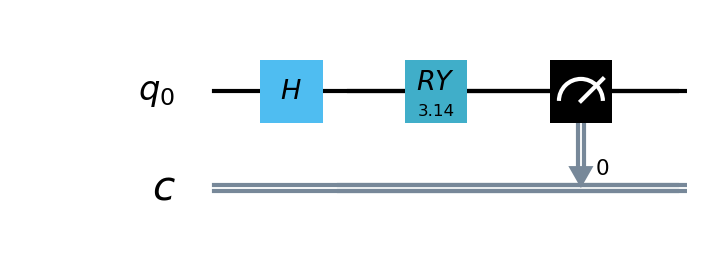
In this example, we use the pyQPanda , A simple quantum circuit of 1 qubit is defined. The circuit takes the output of the classical neural network layer as input,encodes quantum data through H , RY quantum logic gates, and calculates the expected value of Hamiltonian in the z direction as output.
from pyqpanda import *
import pyqpanda as pq
import numpy as np
def circuit(weights):
    num_qubits = 1
    #Use pyQPanda to create a simulator
    machine = pq.CPUQVM()
    machine.init_qvm()
    #Use pyQPanda to alloc qubits
    qubits = machine.qAlloc_many(num_qubits)
    #Use pyQPanda to alloc classic bits
    cbits = machine.cAlloc_many(num_qubits)
    #Construct circuits
    circuit = pq.QCircuit()
    circuit.insert(pq.H(qubits[0]))
    circuit.insert(pq.RY(qubits[0], weights[0]))
    #Construct quantum program
    prog = pq.QProg()
    prog.insert(circuit)
    #Defines measurement
    prog << measure_all(qubits, cbits)

    #run quantum with quantum measurements
    result = machine.run_with_configuration(prog, cbits, 100)

    counts = np.array(list(result.values()))
    states = np.array(list(result.keys())).astype(float)
    probabilities = counts / 100
    expectation = np.sum(states * probabilities)
    return expectation
Create Hybird Model
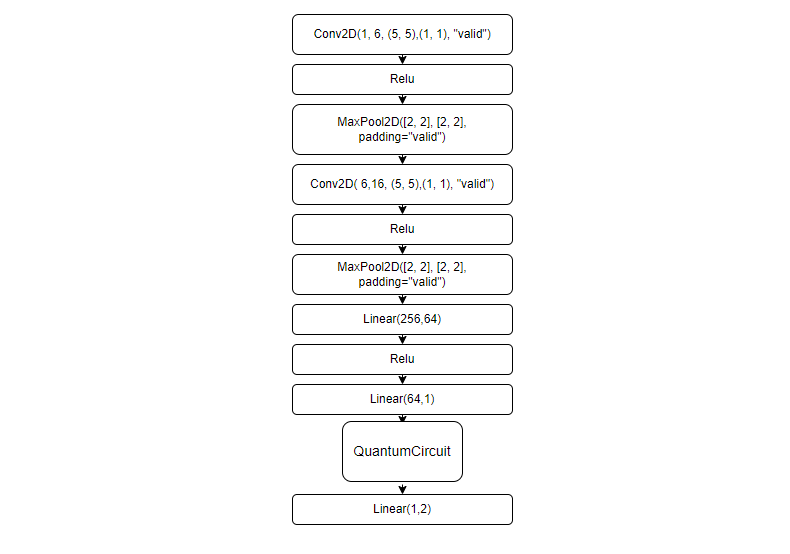
Since quantum circuits can perform automatic differentiation calculations together with classical neural networks,
Therefore, we can use VQNet’s convolutional layer Conv2D , pooling layer MaxPool2D , fully connected layer Linear and
the quantum circuit to build model just now.
The definition of the Net and Hybrid classes inherit from the VQNet automatic differentiation module Module
and the definition of the forward calculation is defined in forward function forward(),
An automatic differentiation Model of convolution, quantum encoding, and measurement of the MNIST data is constructed to obtain the final features required for the classification task.
#Quantum computing layer front pass and the definition of gradient calculation function, which need to be inherited from the abstract class Module
class Hybrid(Module):
    """ Hybrid quantum - Quantum layer definition """
    def __init__(self, shift):
        super(Hybrid, self).__init__()
        self.shift = shift
    def forward(self, input):
        self.input = input
        expectation_z = circuit(np.array(input.data))
        result = [[expectation_z]]
        requires_grad = input.requires_grad and not QTensor.NO_GRAD
        def _backward(g, input):
            """ Backward pass computation """
            input_list = np.array(input.data)
            shift_right = input_list + np.ones(input_list.shape) * self.shift
            shift_left = input_list - np.ones(input_list.shape) * self.shift

            gradients = []
            for i in range(len(input_list)):
                expectation_right = circuit(shift_right[i])
                expectation_left = circuit(shift_left[i])

                gradient = expectation_right - expectation_left
                gradients.append(gradient)
            gradients = np.array([gradients]).T
            return gradients * np.array(g)

        nodes = []
        if input.requires_grad:
            nodes.append(QTensor.GraphNode(tensor=input, df=lambda g: _backward(g, input)))
        return QTensor(data=result, requires_grad=requires_grad, nodes=nodes)

#Model definition
class Net(Module):
    def __init__(self):
        super(Net, self).__init__()
        self.conv1 = Conv2D(input_channels=1, output_channels=6, kernel_size=(5, 5), stride=(1, 1), padding="valid")
        self.maxpool1 = MaxPool2D([2, 2], [2, 2], padding="valid")
        self.conv2 = Conv2D(input_channels=6, output_channels=16, kernel_size=(5, 5), stride=(1, 1), padding="valid")
        self.maxpool2 = MaxPool2D([2, 2], [2, 2], padding="valid")
        self.fc1 = Linear(input_channels=256, output_channels=64)
        self.fc2 = Linear(input_channels=64, output_channels=1)
        self.hybrid = Hybrid(np.pi / 2)
        self.fc3 = Linear(input_channels=1, output_channels=2)

    def forward(self, x):
        x = F.ReLu()(self.conv1(x))  # 1 6 24 24
        x = self.maxpool1(x)
        x = F.ReLu()(self.conv2(x))  # 1 16 8 8
        x = self.maxpool2(x)
        x = tensor.flatten(x, 1)   # 1 256
        x = F.ReLu()(self.fc1(x))  # 1 64
        x = self.fc2(x)    # 1 1
        x = self.hybrid(x)
        x = self.fc3(x)
        return x
Training and testing
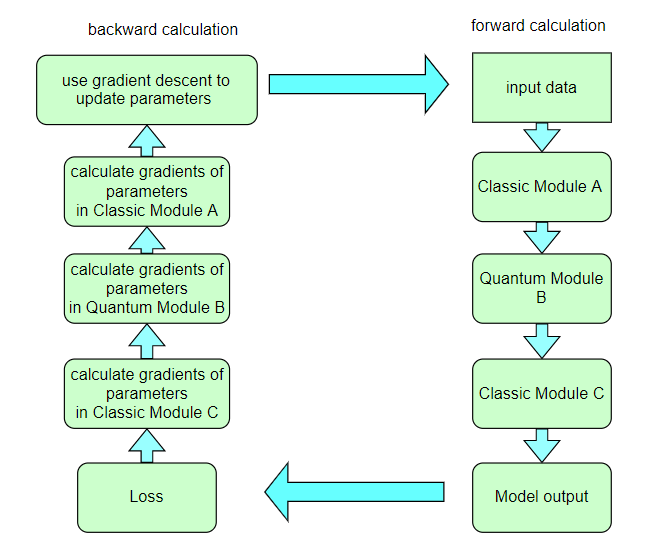
For the hybrid neural network model as shown in the figure below, we calculate the loss function by feeding data into the model iteratively, and VQNet will calculate the gradient of each parameter in the backward calculation automatically, and use the optimizer to optimize the parameters until the number of iterations meets the preset value.
x_train, y_train, x_test, y_test = data_select(1000, 100)

#Create a model
model = Net()
#Use adam optimizer
optimizer = Adam(model.parameters(), lr=0.005)
#Use cross entropy loss
loss_func = CategoricalCrossEntropy()

#train epoches
epochs = 10
train_loss_list = []
val_loss_list = []
train_acc_list =[]
val_acc_list = []


for epoch in range(1, epochs):
    total_loss = []
    model.train()
    batch_size = 1
    correct = 0
    n_train = 0
    for x, y in data_generator(x_train, y_train, batch_size=1, shuffle=True):

        x = x.reshape(-1, 1, 28, 28)

        optimizer.zero_grad()
        output = model(x)
        loss = loss_func(y, output)
        loss_np = np.array(loss.data)

        np_output = np.array(output.data, copy=False)
        mask = (np_output.argmax(1) == y.argmax(1))
        correct += np.sum(np.array(mask))
        n_train += batch_size

        loss.backward()
        optimizer._step()

        total_loss.append(loss_np)

    train_loss_list.append(np.sum(total_loss) / len(total_loss))
    train_acc_list.append(np.sum(correct) / n_train)
    print("{:.0f} loss is : {:.10f}".format(epoch, train_loss_list[-1]))


    model.eval()
    correct = 0
    n_eval = 0

    for x, y in data_generator(x_test, y_test, batch_size=1, shuffle=True):
        x = x.reshape(-1, 1, 28, 28)
        output = model(x)
        loss = loss_func(y, output)
        loss_np = np.array(loss.data)
        np_output = np.array(output.data, copy=False)
        mask = (np_output.argmax(1) == y.argmax(1))
        correct += np.sum(np.array(mask))
        n_eval += 1

        total_loss.append(loss_np)
    print(f"Eval Accuracy: {correct / n_eval}")
    val_loss_list.append(np.sum(total_loss) / len(total_loss))
    val_acc_list.append(np.sum(correct) / n_eval)
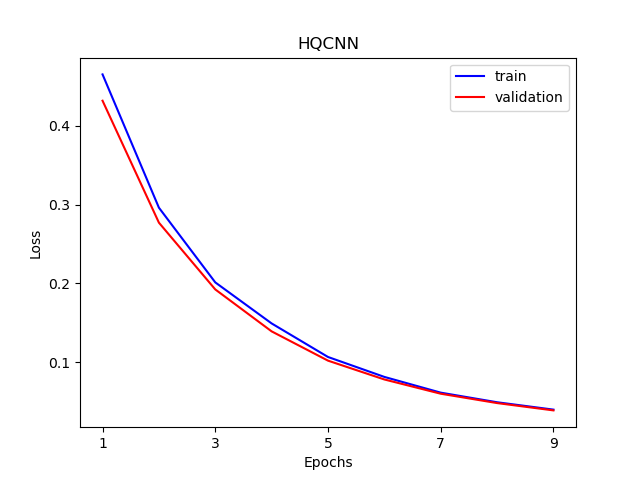
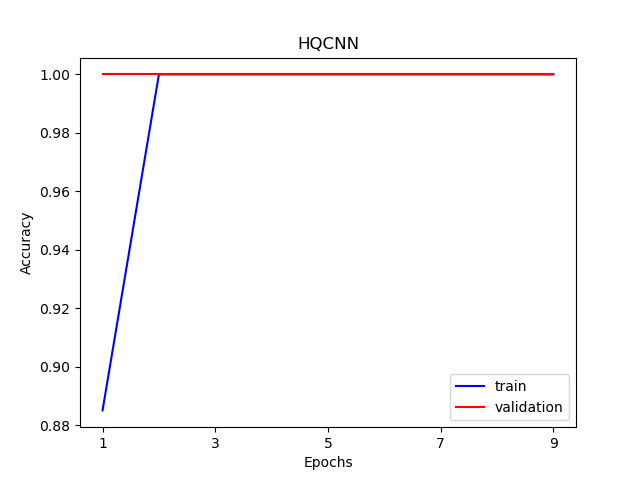
Visualization
The visualization curve of data loss function and accuracy on train and test data.
import os
plt.figure()
xrange = range(1,len(train_loss_list)+1)
figure_path = os.path.join(os.getcwd(), 'HQCNN LOSS.png')
plt.plot(xrange,train_loss_list, color="blue", label="train")
plt.plot(xrange,val_loss_list, color="red", label="validation")
plt.title('HQCNN')
plt.xlabel("Epochs")
plt.ylabel("Loss")
plt.xticks(np.arange(1, epochs +1,step = 2))
plt.legend(loc="upper right")
plt.savefig(figure_path)
plt.show()

plt.figure()
figure_path = os.path.join(os.getcwd(), 'HQCNN Accuracy.png')
plt.plot(xrange,train_acc_list, color="blue", label="train")
plt.plot(xrange,val_acc_list, color="red", label="validation")
plt.title('HQCNN')
plt.xlabel("Epochs")
plt.ylabel("Accuracy")
plt.xticks(np.arange(1, epochs +1,step = 2))
plt.legend(loc="lower right")
plt.savefig(figure_path)
plt.show()
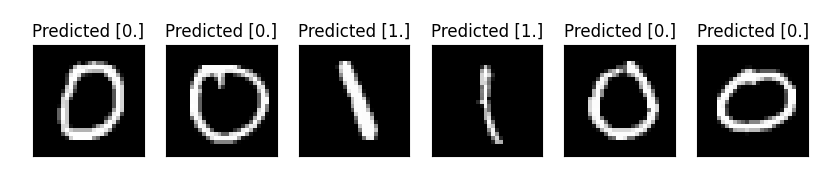
n_samples_show = 6
count = 0
fig, axes = plt.subplots(nrows=1, ncols=n_samples_show, figsize=(10, 3))
model.eval()
for x, y in data_generator(x_test, y_test, batch_size=1, shuffle=True):
    if count == n_samples_show:
        break
    x = x.reshape(-1, 1, 28, 28)
    output = model(x)
    pred = QTensor.argmax(output, [1])
    axes[count].imshow(x[0].squeeze(), cmap='gray')
    axes[count].set_xticks([])
    axes[count].set_yticks([])
    axes[count].set_title('Predicted {}'.format(np.array(pred.data)))
    count += 1
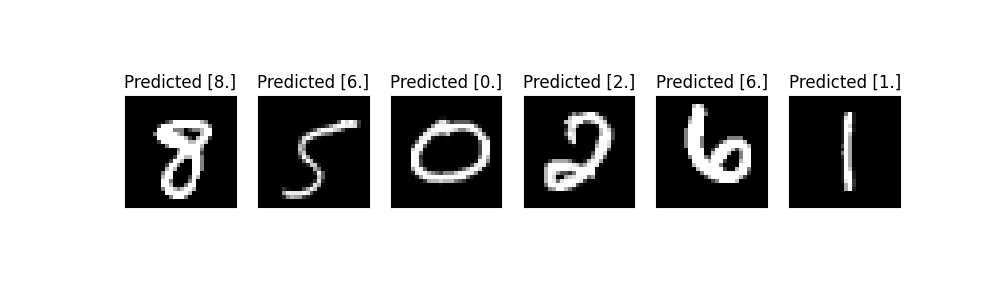
plt.show()
2.Hybrid quantum classical transfer learning model
We apply a machine learning method called transfer learning to image classifier based on hybrid classical quantum network. We will write a simple example of integrating PyQPanda with VQNet.Transfer learning is based on general intuition, that is, if the pre-trained network is good at solving a given problem, it can also be used to solve a different but related problem with only some additional training.
Quantum partial circuit diagram are illustrated below:

"""
Quantum Classic Nerual Network Transfer Learning demo

"""

import os
import sys
sys.path.insert(0,'../')
import numpy as np
import matplotlib.pyplot as plt

from pyvqnet.nn.module import Module
from pyvqnet.nn.linear import Linear
from pyvqnet.nn.conv import Conv2D
from pyvqnet.utils.storage import load_parameters, save_parameters

from pyvqnet.nn import activation as F
from pyvqnet.nn.pooling import MaxPool2D

from pyvqnet.nn.batch_norm import BatchNorm2d
from pyvqnet.nn.loss import SoftmaxCrossEntropy

from pyvqnet.optim.sgd import SGD
from pyvqnet.optim.adam import Adam
from pyvqnet.data.data import data_generator
from pyvqnet.tensor import tensor
from pyvqnet.tensor.tensor import QTensor
import pyqpanda as pq
from pyqpanda import *
import matplotlib
from pyvqnet.nn.module import *
from pyvqnet.utils.initializer import *
from pyvqnet.qnn.quantumlayer import QuantumLayer

try:
    matplotlib.use('TkAgg')
except:
    pass

try:
    import urllib.request
except ImportError:
    raise ImportError('You should use Python 3.x')
import os.path
import gzip

url_base = 'http://yann.lecun.com/exdb/mnist/'
key_file = {
    'train_img':'train-images-idx3-ubyte.gz',
    'train_label':'train-labels-idx1-ubyte.gz',
    'test_img':'t10k-images-idx3-ubyte.gz',
    'test_label':'t10k-labels-idx1-ubyte.gz'
}

def _download(dataset_dir,file_name):
    file_path = dataset_dir + "/" + file_name

    if os.path.exists(file_path):
        with gzip.GzipFile(file_path) as f:
            file_path_ungz = file_path[:-3].replace('\\', '/')
            if not os.path.exists(file_path_ungz):
                open(file_path_ungz,"wb").write(f.read())
        return

    print("Downloading " + file_name + " ... ")
    urllib.request.urlretrieve(url_base + file_name, file_path)
    if os.path.exists(file_path):
            with gzip.GzipFile(file_path) as f:
                file_path_ungz = file_path[:-3].replace('\\', '/')
                file_path_ungz = file_path_ungz.replace('-idx', '.idx')
                if not os.path.exists(file_path_ungz):
                    open(file_path_ungz,"wb").write(f.read())
    print("Done")

def download_mnist(dataset_dir):
    for v in key_file.values():
        _download(dataset_dir,v)


IF_PLOT = False
if not os.path.exists("./result"):
    os.makedirs("./result")
else:
    pass
# classical CNN
class CNN(Module):
    def __init__(self):
        super(CNN, self).__init__()

        self.conv1 = Conv2D(input_channels=1, output_channels=16, kernel_size=(3, 3), stride=(1, 1), padding="valid")
        self.BatchNorm2d1 = BatchNorm2d(16)
        self.Relu1 = F.ReLu()

        self.conv2 = Conv2D(input_channels=16, output_channels=32, kernel_size=(3, 3), stride=(1, 1), padding="valid")
        self.BatchNorm2d2 = BatchNorm2d(32)
        self.Relu2 = F.ReLu()
        self.maxpool2 = MaxPool2D([2, 2], [2, 2], padding="valid")

        self.conv3 = Conv2D(input_channels=32, output_channels=64, kernel_size=(3, 3), stride=(1, 1), padding="valid")
        self.BatchNorm2d3 = BatchNorm2d(64)
        self.Relu3 = F.ReLu()

        self.conv4 = Conv2D(input_channels=64, output_channels=128, kernel_size=(3, 3), stride=(1, 1), padding="valid")
        self.BatchNorm2d4 = BatchNorm2d(128)
        self.Relu4 = F.ReLu()
        self.maxpool4 = MaxPool2D([2, 2], [2, 2], padding="valid")

        self.fc1 = Linear(input_channels=128 * 4 * 4, output_channels=1024)
        self.fc2 = Linear(input_channels=1024, output_channels=128)
        self.fc3 = Linear(input_channels=128, output_channels=10)

    def forward(self, x):

        x = self.Relu1(self.conv1(x))
        x = self.maxpool2(self.Relu2(self.conv2(x)))
        x = self.Relu3(self.conv3(x))
        x = self.maxpool4(self.Relu4(self.conv4(x)))
        x = tensor.flatten(x, 1)
        x = F.ReLu()(self.fc1(x))  # 1 64
        x = F.ReLu()(self.fc2(x))  # 1 64
        x = self.fc3(x)  # 1 1
        return x

def load_mnist(dataset="training_data", digits=np.arange(2), path="./"):         # 下载数据
    import os, struct
    from array import array as pyarray
    download_mnist(path)
    if dataset == "training_data":
        fname_image = os.path.join(path, 'train-images.idx3-ubyte').replace('\\', '/')
        fname_label = os.path.join(path, 'train-labels.idx1-ubyte').replace('\\', '/')
    elif dataset == "testing_data":
        fname_image = os.path.join(path, 't10k-images.idx3-ubyte').replace('\\', '/')
        fname_label = os.path.join(path, 't10k-labels.idx1-ubyte').replace('\\', '/')
    else:
        raise ValueError("dataset must be 'training_data' or 'testing_data'")

    flbl = open(fname_label, 'rb')
    magic_nr, size = struct.unpack(">II", flbl.read(8))
    lbl = pyarray("b", flbl.read())
    flbl.close()

    fimg = open(fname_image, 'rb')
    magic_nr, size, rows, cols = struct.unpack(">IIII", fimg.read(16))
    img = pyarray("B", fimg.read())
    fimg.close()

    ind = [k for k in range(size) if lbl[k] in digits]
    N = len(ind)
    images = np.zeros((N, rows, cols))
    labels = np.zeros((N, 1), dtype=int)
    for i in range(len(ind)):
        images[i] = np.array(img[ind[i] * rows * cols: (ind[i] + 1) * rows * cols]).reshape((rows, cols))
        labels[i] = lbl[ind[i]]

    return images, labels


"""
to get cnn model parameters for transfer learning
"""

train_size = 10000
eval_size = 1000
EPOCHES = 100
def classcal_cnn_model_making():
    # load train data
    x_train, y_train = load_mnist("training_data", digits=np.arange(10))
    x_test, y_test = load_mnist("testing_data", digits=np.arange(10))

    x_train = x_train[:train_size]
    y_train = y_train[:train_size]
    x_test = x_test[:eval_size]
    y_test = y_test[:eval_size]

    x_train = x_train / 255
    x_test = x_test / 255
    y_train = np.eye(10)[y_train].reshape(-1, 10)
    y_test = np.eye(10)[y_test].reshape(-1, 10)

    model = CNN()

    optimizer = SGD(model.parameters(), lr=0.005)
    loss_func = SoftmaxCrossEntropy()

    epochs = EPOCHES
    loss_list = []
    model.train()

    SAVE_FLAG = True
    temp_loss = 0
    for epoch in range(1, epochs):
        total_loss = []
        for x, y in data_generator(x_train, y_train, batch_size=4, shuffle=True):

            x = x.reshape(-1, 1, 28, 28)
            optimizer.zero_grad()
            # Forward pass
            output = model(x)

            # Calculating loss
            loss = loss_func(y, output)  # target output
            loss_np = np.array(loss.data)
            # Backward pass
            loss.backward()
            # Optimize the weights
            optimizer._step()

            total_loss.append(loss_np)

        loss_list.append(np.sum(total_loss) / len(total_loss))
        print("{:.0f} loss is : {:.10f}".format(epoch, loss_list[-1]))

        if SAVE_FLAG:
            temp_loss = loss_list[-1]
            save_parameters(model.state_dict(), "./result/QCNN_TL_1.model")
            SAVE_FLAG = False
        else:
            if temp_loss > loss_list[-1]:
                temp_loss = loss_list[-1]
                save_parameters(model.state_dict(), "./result/QCNN_TL_1.model")


    model.eval()
    correct = 0
    n_eval = 0

    for x, y in data_generator(x_test, y_test, batch_size=4, shuffle=True):
        x = x.reshape(-1, 1, 28, 28)
        output = model(x)
        loss = loss_func(y, output)
        np_output = np.array(output.data, copy=False)
        mask = (np_output.argmax(1) == y.argmax(1))
        correct += np.sum(np.array(mask))
        n_eval += 1
    print(f"Eval Accuracy: {correct / n_eval}")

    n_samples_show = 6
    count = 0
    fig, axes = plt.subplots(nrows=1, ncols=n_samples_show, figsize=(10, 3))
    model.eval()
    for x, y in data_generator(x_test, y_test, batch_size=1, shuffle=True):
        if count == n_samples_show:
            break
        x = x.reshape(-1, 1, 28, 28)
        output = model(x)
        pred = QTensor.argmax(output, [1])
        axes[count].imshow(x[0].squeeze(), cmap='gray')
        axes[count].set_xticks([])
        axes[count].set_yticks([])
        axes[count].set_title('Predicted {}'.format(np.array(pred.data)))
        count += 1
    plt.show()

def classical_cnn_TransferLearning_predict():
    x_test, y_test = load_mnist("testing_data", digits=np.arange(10))

    x_test = x_test[:eval_size]
    y_test = y_test[:eval_size]
    x_test = x_test / 255
    y_test = np.eye(10)[y_test].reshape(-1, 10)
    model = CNN()

    model_parameter = load_parameters("./result/QCNN_TL_1.model")
    model.load_state_dict(model_parameter)
    model.eval()
    correct = 0
    n_eval = 0

    for x, y in data_generator(x_test, y_test, batch_size=1, shuffle=True):
        x = x.reshape(-1, 1, 28, 28)
        output = model(x)

        np_output = np.array(output.data, copy=False)
        mask = (np_output.argmax(1) == y.argmax(1))
        correct += np.sum(np.array(mask))
        n_eval += 1

    print(f"Eval Accuracy: {correct / n_eval}")

    n_samples_show = 6
    count = 0
    fig, axes = plt.subplots(nrows=1, ncols=n_samples_show, figsize=(10, 3))
    model.eval()
    for x, y in data_generator(x_test, y_test, batch_size=1, shuffle=True):
        if count == n_samples_show:
            break
        x = x.reshape(-1, 1, 28, 28)
        output = model(x)
        pred = QTensor.argmax(output, [1])
        axes[count].imshow(x[0].squeeze(), cmap='gray')
        axes[count].set_xticks([])
        axes[count].set_yticks([])
        axes[count].set_title('Predicted {}'.format(np.array(pred.data)))
        count += 1
    plt.show()

def quantum_cnn_TransferLearning():

    n_qubits = 4  # Number of qubits
    q_depth = 6  # Depth of the quantum circuit (number of variational layers)

    def Q_H_layer(qubits, nqubits):
        """Layer of single-qubit Hadamard gates.
        """
        circuit = pq.QCircuit()
        for idx in range(nqubits):
            circuit.insert(pq.H(qubits[idx]))
        return circuit

    def Q_RY_layer(qubits, w):
        """Layer of parametrized qubit rotations around the y axis.
        """
        circuit = pq.QCircuit()
        for idx, element in enumerate(w):
            circuit.insert(pq.RY(qubits[idx], element))
        return circuit

    def Q_entangling_layer(qubits, nqubits):
        """Layer of CNOTs followed by another shifted layer of CNOT.
        """
        # In other words it should apply something like :
        # CNOT  CNOT  CNOT  CNOT...  CNOT
        #   CNOT  CNOT  CNOT...  CNOT
        circuit = pq.QCircuit()
        for i in range(0, nqubits - 1, 2):  # Loop over even indices: i=0,2,...N-2
            circuit.insert(pq.CNOT(qubits[i], qubits[i + 1]))
        for i in range(1, nqubits - 1, 2):  # Loop over odd indices:  i=1,3,...N-3
            circuit.insert(pq.CNOT(qubits[i], qubits[i + 1]))
        return circuit

    def Q_quantum_net(q_input_features, q_weights_flat, qubits, cubits, machine):
        """
        The variational quantum circuit.
        """
        machine = pq.CPUQVM()
        machine.init_qvm()
        qubits = machine.qAlloc_many(n_qubits)
        circuit = pq.QCircuit()

        # Reshape weights
        q_weights = q_weights_flat.reshape([q_depth, n_qubits])

        # Start from state |+> , unbiased w.r.t. |0> and |1>
        circuit.insert(Q_H_layer(qubits, n_qubits))

        # Embed features in the quantum node
        circuit.insert(Q_RY_layer(qubits, q_input_features))

        # Sequence of trainable variational layers
        for k in range(q_depth):
            circuit.insert(Q_entangling_layer(qubits, n_qubits))
            circuit.insert(Q_RY_layer(qubits, q_weights[k]))

        # Expectation values in the Z basis
        prog = pq.QProg()
        prog.insert(circuit)

        exp_vals = []
        for position in range(n_qubits):
            pauli_str = "Z" + str(position)
            pauli_map = pq.PauliOperator(pauli_str, 1)
            hamiltion = pauli_map.toHamiltonian(True)
            exp = machine.get_expectation(prog, hamiltion, qubits)
            exp_vals.append(exp)

        return exp_vals

    class Q_DressedQuantumNet(Module):

        def __init__(self):
            """
            Definition of the *dressed* layout.
            """

            super().__init__()
            self.pre_net = Linear(128, n_qubits)
            self.post_net = Linear(n_qubits, 10)
            self.temp_Q = QuantumLayer(Q_quantum_net, q_depth * n_qubits, "cpu", n_qubits, n_qubits)

        def forward(self, input_features):
            """
            Defining how tensors are supposed to move through the *dressed* quantum
            net.
            """

            # obtain the input features for the quantum circuit
            # by reducing the feature dimension from 512 to 4
            pre_out = self.pre_net(input_features)
            q_in = tensor.tanh(pre_out) * np.pi / 2.0
            q_out_elem = self.temp_Q(q_in)

            result = q_out_elem
            # return the two-dimensional prediction from the postprocessing layer
            return self.post_net(result)

    x_train, y_train = load_mnist("training_data", digits=np.arange(10))
    x_test, y_test = load_mnist("testing_data", digits=np.arange(10))
    x_train = x_train[:train_size]
    y_train = y_train[:train_size]
    x_test = x_test[:eval_size]
    y_test = y_test[:eval_size]

    x_train = x_train / 255
    x_test = x_test / 255
    y_train = np.eye(10)[y_train].reshape(-1, 10)
    y_test = np.eye(10)[y_test].reshape(-1, 10)

    model = CNN()
    model_param = load_parameters("./result/QCNN_TL_1.model")
    model.load_state_dict(model_param)

    loss_func = SoftmaxCrossEntropy()

    epochs = EPOCHES
    loss_list = []
    eval_losses = []

    model_hybrid = model
    print(model_hybrid)

    for param in model_hybrid.parameters():
        param.requires_grad = False
    model_hybrid.fc3 = Q_DressedQuantumNet()
    optimizer_hybrid = Adam(model_hybrid.fc3.parameters(), lr=0.001)
    model_hybrid.train()

    SAVE_FLAG = True
    temp_loss = 0
    for epoch in range(1, epochs):
        total_loss = []
        for x, y in data_generator(x_train, y_train, batch_size=4, shuffle=True):
            x = x.reshape(-1, 1, 28, 28)
            optimizer_hybrid.zero_grad()
            # Forward pass
            output = model_hybrid(x)

            loss = loss_func(y, output)  # target output
            loss_np = np.array(loss.data)
            # Backward pass
            loss.backward()
            # Optimize the weights
            optimizer_hybrid._step()
            total_loss.append(loss_np)

        loss_list.append(np.sum(total_loss) / len(total_loss))
        print("{:.0f} loss is : {:.10f}".format(epoch, loss_list[-1]))
        if SAVE_FLAG:
            temp_loss = loss_list[-1]
            save_parameters(model_hybrid.fc3.state_dict(), "./result/QCNN_TL_FC3.model")
            save_parameters(model_hybrid.state_dict(), "./result/QCNN_TL_ALL.model")
            SAVE_FLAG = False
        else:
            if temp_loss > loss_list[-1]:
                temp_loss = loss_list[-1]
                save_parameters(model_hybrid.fc3.state_dict(), "./result/QCNN_TL_FC3.model")
                save_parameters(model_hybrid.state_dict(), "./result/QCNN_TL_ALL.model")

        correct = 0
        n_eval = 0
        loss_temp =[]
        for x1, y1 in data_generator(x_test, y_test, batch_size=4, shuffle=True):
            x1 = x1.reshape(-1, 1, 28, 28)
            output = model_hybrid(x1)
            loss = loss_func(y1, output)
            np_loss = np.array(loss.data)
            np_output = np.array(output.data, copy=False)
            mask = (np_output.argmax(1) == y1.argmax(1))
            correct += np.sum(np.array(mask))
            n_eval += 1
            loss_temp.append(np_loss)
        eval_losses.append(np.sum(loss_temp) / n_eval)
        print("{:.0f} eval loss is : {:.10f}".format(epoch, eval_losses[-1]))


    plt.title('model loss')
    plt.plot(loss_list, color='green', label='train_losses')
    plt.plot(eval_losses, color='red', label='eval_losses')
    plt.ylabel('loss')
    plt.legend(["train_losses", "eval_losses"])
    plt.savefig("qcnn_transfer_learning_classical")
    plt.show()
    plt.close()

    n_samples_show = 6
    count = 0
    fig, axes = plt.subplots(nrows=1, ncols=n_samples_show, figsize=(10, 3))
    model_hybrid.eval()
    for x, y in data_generator(x_test, y_test, batch_size=1, shuffle=True):
        if count == n_samples_show:
            break
        x = x.reshape(-1, 1, 28, 28)
        output = model_hybrid(x)
        pred = QTensor.argmax(output, [1])
        axes[count].imshow(x[0].squeeze(), cmap='gray')
        axes[count].set_xticks([])
        axes[count].set_yticks([])
        axes[count].set_title('Predicted {}'.format(np.array(pred.data)))
        count += 1
    plt.show()

def quantum_cnn_TransferLearning_predict():

    n_qubits = 4  # Number of qubits
    q_depth = 6  # Depth of the quantum circuit (number of variational layers)

    def Q_H_layer(qubits, nqubits):
        """Layer of single-qubit Hadamard gates.
        """
        circuit = pq.QCircuit()
        for idx in range(nqubits):
            circuit.insert(pq.H(qubits[idx]))
        return circuit

    def Q_RY_layer(qubits, w):
        """Layer of parametrized qubit rotations around the y axis.
        """
        circuit = pq.QCircuit()
        for idx, element in enumerate(w):
            circuit.insert(pq.RY(qubits[idx], element))
        return circuit

    def Q_entangling_layer(qubits, nqubits):
        """Layer of CNOTs followed by another shifted layer of CNOT.
        """
        # In other words it should apply something like :
        # CNOT  CNOT  CNOT  CNOT...  CNOT
        #   CNOT  CNOT  CNOT...  CNOT
        circuit = pq.QCircuit()
        for i in range(0, nqubits - 1, 2):  # Loop over even indices: i=0,2,...N-2
            circuit.insert(pq.CNOT(qubits[i], qubits[i + 1]))
        for i in range(1, nqubits - 1, 2):  # Loop over odd indices:  i=1,3,...N-3
            circuit.insert(pq.CNOT(qubits[i], qubits[i + 1]))
        return circuit

    def Q_quantum_net(q_input_features, q_weights_flat, qubits, cubits, machine):
        """
        The variational quantum circuit.
        """
        machine = pq.CPUQVM()
        machine.init_qvm()
        qubits = machine.qAlloc_many(n_qubits)
        circuit = pq.QCircuit()

        # Reshape weights
        q_weights = q_weights_flat.reshape([q_depth, n_qubits])

        # Start from state |+> , unbiased w.r.t. |0> and |1>
        circuit.insert(Q_H_layer(qubits, n_qubits))

        # Embed features in the quantum node
        circuit.insert(Q_RY_layer(qubits, q_input_features))

        # Sequence of trainable variational layers
        for k in range(q_depth):
            circuit.insert(Q_entangling_layer(qubits, n_qubits))
            circuit.insert(Q_RY_layer(qubits, q_weights[k]))

        # Expectation values in the Z basis
        prog = pq.QProg()
        prog.insert(circuit)
        exp_vals = []
        for position in range(n_qubits):
            pauli_str = "Z" + str(position)
            pauli_map = pq.PauliOperator(pauli_str, 1)
            hamiltion = pauli_map.toHamiltonian(True)
            exp = machine.get_expectation(prog, hamiltion, qubits)
            exp_vals.append(exp)

        return exp_vals

    class Q_DressedQuantumNet(Module):

        def __init__(self):
            """
            Definition of the *dressed* layout.
            """

            super().__init__()
            self.pre_net = Linear(128, n_qubits)
            self.post_net = Linear(n_qubits, 10)
            self.temp_Q = QuantumLayer(Q_quantum_net, q_depth * n_qubits, "cpu", n_qubits, n_qubits)

        def forward(self, input_features):
            """
            Defining how tensors are supposed to move through the *dressed* quantum
            net.
            """

            # obtain the input features for the quantum circuit
            # by reducing the feature dimension from 512 to 4
            pre_out = self.pre_net(input_features)
            q_in = tensor.tanh(pre_out) * np.pi / 2.0
            q_out_elem = self.temp_Q(q_in)

            result = q_out_elem
            # return the two-dimensional prediction from the postprocessing layer
            return self.post_net(result)

    x_train, y_train = load_mnist("training_data", digits=np.arange(10))
    x_test, y_test = load_mnist("testing_data", digits=np.arange(10))
    x_train = x_train[:2000]
    y_train = y_train[:2000]
    x_test = x_test[:500]
    y_test = y_test[:500]

    x_train = x_train / 255
    x_test = x_test / 255
    y_train = np.eye(10)[y_train].reshape(-1, 10)
    y_test = np.eye(10)[y_test].reshape(-1, 10)

    model = CNN()
    model_hybrid = model
    model_hybrid.fc3 = Q_DressedQuantumNet()
    for param in model_hybrid.parameters():
        param.requires_grad = False
    model_param_quantum = load_parameters("./result/QCNN_TL_ALL.model")

    model_hybrid.load_state_dict(model_param_quantum)
    model_hybrid.eval()

    loss_func = SoftmaxCrossEntropy()
    eval_losses = []

    correct = 0
    n_eval = 0
    loss_temp =[]
    eval_batch_size = 4
    for x1, y1 in data_generator(x_test, y_test, batch_size=eval_batch_size, shuffle=True):
        x1 = x1.reshape(-1, 1, 28, 28)
        output = model_hybrid(x1)
        loss = loss_func(y1, output)
        np_loss = np.array(loss.data)
        np_output = np.array(output.data, copy=False)
        mask = (np_output.argmax(1) == y1.argmax(1))
        correct += np.sum(np.array(mask))

        n_eval += 1
        loss_temp.append(np_loss)

    eval_losses.append(np.sum(loss_temp) / n_eval)
    print(f"Eval Accuracy: {correct / (eval_batch_size*n_eval)}")

    n_samples_show = 6
    count = 0
    fig, axes = plt.subplots(nrows=1, ncols=n_samples_show, figsize=(10, 3))
    model_hybrid.eval()
    for x, y in data_generator(x_test, y_test, batch_size=1, shuffle=True):
        if count == n_samples_show:
            break
        x = x.reshape(-1, 1, 28, 28)
        output = model_hybrid(x)
        pred = QTensor.argmax(output, [1])
        axes[count].imshow(x[0].squeeze(), cmap='gray')
        axes[count].set_xticks([])
        axes[count].set_yticks([])
        axes[count].set_title('Predicted {}'.format(np.array(pred.data)))
        count += 1
    plt.show()

if __name__ == "__main__":
    # save classic model parameters
    if not os.path.exists('./result/QCNN_TL_1.model'):
        classcal_cnn_model_making()
        classical_cnn_TransferLearning_predict()
    #train quantum circuits.
    print("use exist cnn model param to train quantum parameters.")
    quantum_cnn_TransferLearning()
    #eval quantum circuits.
    quantum_cnn_TransferLearning_predict()
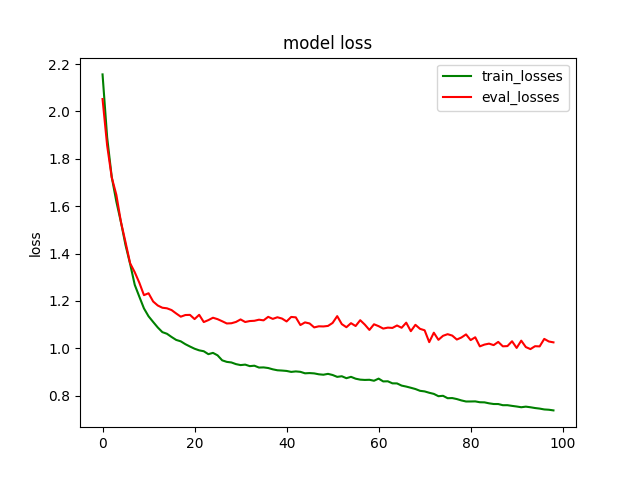
Loss on training set
Run classification on test set
3.Hybrid quantum classical Unet network model
Image segmentation Image segmentation is a classical problem in the research of computer vision and has become a hot spot in the field of image understanding. Image segmentation an important part of image understanding, and one of the most difficult problems in image processing. The so-called image segmentation refers to the segmentation based on gray, color and spatial texture The image is divided into several disjoint regions by features such as theory and geometry, so that these features show consistency or similarity in the same region and obvious differences between different regions. In short, it is to give a picture and classify each pixel on the picture. Separate the pixel regions belonging to different objects. Unet is a classical image segmentation algorithm.
Here, we explore how to partially quantify the classical neural network to create a hybrid quantum classical QUnet neural network. We will write a simple example of integrating pyQPanda with VQNet . Qunet is mainly used to solve the technology of image segmentation.
Data preparation
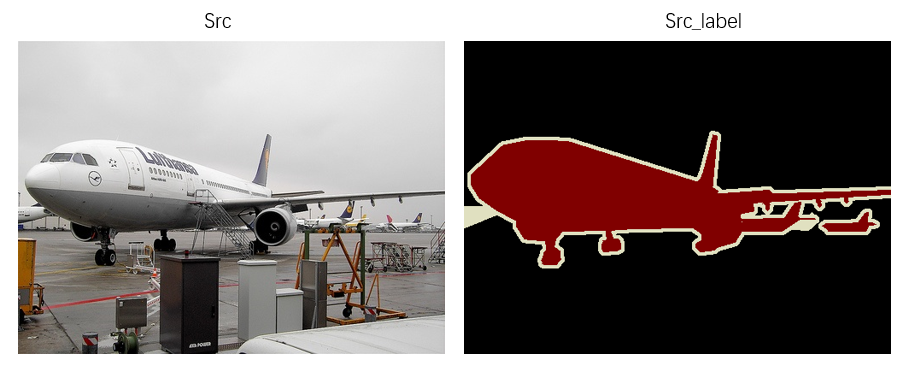
We will use the data of VOC2012 official library as image segmentation data. These samples are divided into training data training_data and test data testing_data.
Constructing quantum circuits
In this example, we define a quantum circuit using pyqpanda of the source quantum. The input 3-channel color image data is compressed into a single channel gray image and stored, and then the feature of the data is extracted and dimensionality reduced by quantum convolution operation.

Import necessary libraries and functions
import os
import numpy as np
from pyvqnet.nn.module import Module
from pyvqnet.nn.conv import Conv2D, ConvT2D
from pyvqnet.nn import activation as F
from pyvqnet.nn.batch_norm import BatchNorm2d
from pyvqnet.nn.loss import BinaryCrossEntropy
from pyvqnet.optim.adam import Adam

from pyvqnet.tensor import tensor
from pyvqnet.tensor.tensor import QTensor
import pyqpanda as pq
from pyqpanda import *
from pyvqnet.utils.storage import load_parameters, save_parameters

import matplotlib
try:
    matplotlib.use('TkAgg')
except:
    pass
import matplotlib.pyplot as plt

import cv2
Preprocessing data
# Preprocessing data
class PreprocessingData:
    def __init__(self, path):
        self.path = path
        self.x_data = []
        self.y_label = []


    def processing(self):
        list_path = os.listdir((self.path+"/images"))
        for i in range(len(list_path)):

            temp_data = cv2.imread(self.path+"/images" + '/' + list_path[i], cv2.IMREAD_COLOR)
            temp_data = cv2.resize(temp_data, (128, 128))
            grayimg = cv2.cvtColor(temp_data, cv2.COLOR_BGR2GRAY)
            temp_data = grayimg.reshape(temp_data.shape[0], temp_data.shape[0], 1)
            self.x_data.append(temp_data)

            label_data = cv2.imread(self.path+"/labels" + '/' +list_path[i].split(".")[0] + ".png", cv2.IMREAD_COLOR)
            label_data = cv2.resize(label_data, (128, 128))

            label_data = cv2.cvtColor(label_data, cv2.COLOR_BGR2GRAY)
            label_data = label_data.reshape(label_data.shape[0], label_data.shape[0], 1)
            self.y_label.append(label_data)

        return self.x_data, self.y_label

    def read(self):
        self.x_data, self.y_label = self.processing()
        x_data = np.array(self.x_data)
        y_label = np.array(self.y_label)

        return x_data, y_label

# Quantum coding circuit
class QCNN_:
    def __init__(self, image):
        self.image = image

    def encode_cir(self, qlist, pixels):
        cir = pq.QCircuit()
        for i, pix in enumerate(pixels):
            theta = np.arctan(pix)
            phi = np.arctan(pix**2)
            cir.insert(pq.RY(qlist[i], theta))
            cir.insert(pq.RZ(qlist[i], phi))
        return cir

    def entangle_cir(self, qlist):
        k_size = len(qlist)
        cir = pq.QCircuit()
        for i in range(k_size):
            ctr = i
            ctred = i+1
            if ctred == k_size:
                ctred = 0
            cir.insert(pq.CNOT(qlist[ctr], qlist[ctred]))
        return cir

    def qcnn_circuit(self, pixels):
        k_size = len(pixels)
        machine = pq.MPSQVM()
        machine.init_qvm()
        qlist = machine.qAlloc_many(k_size)
        cir = pq.QProg()

        cir.insert(self.encode_cir(qlist, np.array(pixels) * np.pi / 2))
        cir.insert(self.entangle_cir(qlist))

        result0 = machine.prob_run_list(cir, [qlist[0]], -1)
        result1 = machine.prob_run_list(cir, [qlist[1]], -1)
        result2 = machine.prob_run_list(cir, [qlist[2]], -1)
        result3 = machine.prob_run_list(cir, [qlist[3]], -1)

        result = [result0[-1]+result1[-1]+result2[-1]+result3[-1]]
        machine.finalize()
        return result

def quanconv_(image):
    """Convolves the input image with many applications of the same quantum circuit."""
    out = np.zeros((64, 64, 1))

    for j in range(0, 128, 2):
        for k in range(0, 128, 2):
            # Process a squared 2x2 region of the image with a quantum circuit
            q_results = QCNN_(image).qcnn_circuit(
                [
                    image[j, k, 0],
                    image[j, k + 1, 0],
                    image[j + 1, k, 0],
                    image[j + 1, k + 1, 0]
                ]
            )

            for c in range(1):
                out[j // 2, k // 2, c] = q_results[c]
    return out

def quantum_data_preprocessing(images):
    quantum_images = []
    for _, img in enumerate(images):
        quantum_images.append(quanconv_(img))
    quantum_images = np.asarray(quantum_images)
    return quantum_images
Constructing hybrid classical quantum neural network
According to the Unet network framework, we use the VQNet framework to build the classic network part. The down-sampling neural network layer is used to reduce the dimension and extract features; The up-sampling neural network layer is used to restore the dimension; The up and down sampling layers are connected through concatenate for feature fusion.
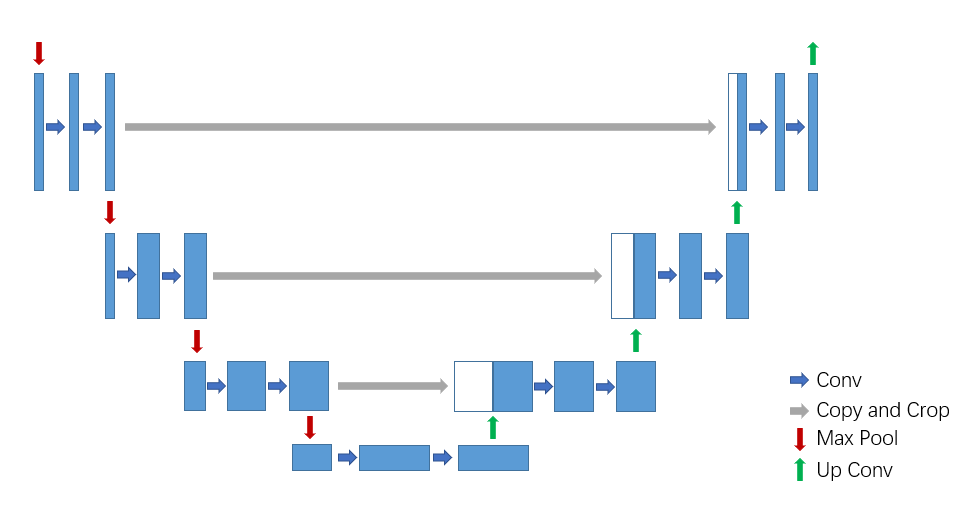
# Definition of down sampling neural network layer
class DownsampleLayer(Module):
    def __init__(self, in_ch, out_ch):
        super(DownsampleLayer, self).__init__()
        self.conv1 = Conv2D(input_channels=in_ch, output_channels=out_ch, kernel_size=(3, 3), stride=(1, 1),
                            padding="same")
        self.BatchNorm2d1 = BatchNorm2d(out_ch)
        self.Relu1 = F.ReLu()
        self.conv2 = Conv2D(input_channels=out_ch, output_channels=out_ch, kernel_size=(3, 3), stride=(1, 1),
                            padding="same")
        self.BatchNorm2d2 = BatchNorm2d(out_ch)
        self.Relu2 = F.ReLu()
        self.conv3 = Conv2D(input_channels=out_ch, output_channels=out_ch, kernel_size=(3, 3), stride=(2, 2),
                            padding="same")
        self.BatchNorm2d3 = BatchNorm2d(out_ch)
        self.Relu3 = F.ReLu()

    def forward(self, x):
        """
        :param x:
        :return: out(Output to deep),out_2(enter to next level),
        """
        x1 = self.conv1(x)
        x2 = self.BatchNorm2d1(x1)
        x3 = self.Relu1(x2)
        x4 = self.conv2(x3)
        x5 = self.BatchNorm2d2(x4)
        out = self.Relu2(x5)
        x6 = self.conv3(out)
        x7 = self.BatchNorm2d3(x6)
        out_2 = self.Relu3(x7)
        return out, out_2

# Definition of up sampling neural network layer
class UpSampleLayer(Module):
    def __init__(self, in_ch, out_ch):
        super(UpSampleLayer, self).__init__()

        self.conv1 = Conv2D(input_channels=in_ch, output_channels=out_ch * 2, kernel_size=(3, 3), stride=(1, 1),
                            padding="same")
        self.BatchNorm2d1 = BatchNorm2d(out_ch * 2)
        self.Relu1 = F.ReLu()
        self.conv2 = Conv2D(input_channels=out_ch * 2, output_channels=out_ch * 2, kernel_size=(3, 3), stride=(1, 1),
                            padding="same")
        self.BatchNorm2d2 = BatchNorm2d(out_ch * 2)
        self.Relu2 = F.ReLu()

        self.conv3 = ConvT2D(input_channels=out_ch * 2, output_channels=out_ch, kernel_size=(3, 3), stride=(2, 2),
                             padding="same")
        self.BatchNorm2d3 = BatchNorm2d(out_ch)
        self.Relu3 = F.ReLu()

    def forward(self, x):
        '''
        :param x: input conv layer
        :param out: connect with UpsampleLayer
        :return:
        '''
        x = self.conv1(x)
        x = self.BatchNorm2d1(x)
        x = self.Relu1(x)
        x = self.conv2(x)
        x = self.BatchNorm2d2(x)
        x = self.Relu2(x)
        x = self.conv3(x)
        x = self.BatchNorm2d3(x)
        x_out = self.Relu3(x)
        return x_out

# Unet overall network architecture
class UNet(Module):
    def __init__(self):
        super(UNet, self).__init__()
        out_channels = [2 ** (i + 4) for i in range(5)]

        # DownSampleLayer
        self.d1 = DownsampleLayer(1, out_channels[0])  # 3-64
        self.d2 = DownsampleLayer(out_channels[0], out_channels[1])  # 64-128
        self.d3 = DownsampleLayer(out_channels[1], out_channels[2])  # 128-256
        self.d4 = DownsampleLayer(out_channels[2], out_channels[3])  # 256-512
        # UpSampleLayer
        self.u1 = UpSampleLayer(out_channels[3], out_channels[3])  # 512-1024-512
        self.u2 = UpSampleLayer(out_channels[4], out_channels[2])  # 1024-512-256
        self.u3 = UpSampleLayer(out_channels[3], out_channels[1])  # 512-256-128
        self.u4 = UpSampleLayer(out_channels[2], out_channels[0])  # 256-128-64
        # output
        self.conv1 = Conv2D(input_channels=out_channels[1], output_channels=out_channels[0], kernel_size=(3, 3),
                            stride=(1, 1), padding="same")
        self.BatchNorm2d1 = BatchNorm2d(out_channels[0])
        self.Relu1 = F.ReLu()
        self.conv2 = Conv2D(input_channels=out_channels[0], output_channels=out_channels[0], kernel_size=(3, 3),
                            stride=(1, 1), padding="same")
        self.BatchNorm2d2 = BatchNorm2d(out_channels[0])
        self.Relu2 = F.ReLu()
        self.conv3 = Conv2D(input_channels=out_channels[0], output_channels=1, kernel_size=(3, 3),
                            stride=(1, 1), padding="same")
        self.Sigmoid = F.Sigmoid()

    def forward(self, x):
        out_1, out1 = self.d1(x)
        out_2, out2 = self.d2(out1)
        out_3, out3 = self.d3(out2)
        out_4, out4 = self.d4(out3)

        out5 = self.u1(out4)
        cat_out5 = tensor.concatenate([out5, out_4], axis=1)
        out6 = self.u2(cat_out5)
        cat_out6 = tensor.concatenate([out6, out_3], axis=1)
        out7 = self.u3(cat_out6)
        cat_out7 = tensor.concatenate([out7, out_2], axis=1)
        out8 = self.u4(cat_out7)
        cat_out8 = tensor.concatenate([out8, out_1], axis=1)
        out = self.conv1(cat_out8)
        out = self.BatchNorm2d1(out)
        out = self.Relu1(out)
        out = self.conv2(out)
        out = self.BatchNorm2d2(out)
        out = self.Relu2(out)
        out = self.conv3(out)
        out = self.Sigmoid(out)
        return out
Training and model saving
Similar to the training of classical neural network model, we also need to instantiate the model, define the loss function and optimizer, and define the whole training and testing process. For the hybrid neural network model as shown in the figure below, we calculate the loss value in forward function the gradient of each parameter in reverse calculation automatically, and use the optimizer to optimize the parameters until the number of iterations meets the preset value.
class MyDataset():
    def __init__(self, x_data, x_label):
        self.x_set = x_data
        self.label = x_label

    def __getitem__(self, item):
        img, target = self.x_set[item], self.label[item]
        img_np = np.uint8(img).transpose(2, 0, 1)
        target_np = np.uint8(target).transpose(2, 0, 1)

        img = img_np
        target = target_np
        return img, target

    def __len__(self):
        return len(self.x_set)

if not os.path.exists("./result"):
    os.makedirs("./result")
else:
    pass
if not os.path.exists("./Intermediate_results"):
    os.makedirs("./Intermediate_results")
else:
    pass

# prepare train/test data and label
path0 = 'training_data'
path1 = 'testing_data'
train_images, train_labels = PreprocessingData(path0).read()
test_images, test_labels = PreprocessingData(path1).read()

print('train: ', train_images.shape, '\ntest: ', test_images.shape)
print('train: ', train_labels.shape, '\ntest: ', test_labels.shape)
train_images = train_images / 255
test_images = test_images / 255

# use quantum encoder to preprocess data
# PREPROCESS = True
PREPROCESS = False

if PREPROCESS == True:
    print("Quantum pre-processing of train images:")
    q_train_images = quantum_data_preprocessing(train_images)
    q_test_images = quantum_data_preprocessing(test_images)
    q_train_label = quantum_data_preprocessing(train_labels)
    q_test_label = quantum_data_preprocessing(test_labels)

    # Save pre-processed images
    print('Quantum Data Saving...')
    np.save("./result/q_train.npy", q_train_images)
    np.save("./result/q_test.npy", q_test_images)
    np.save("./result/q_train_label.npy", q_train_label)
    np.save("./result/q_test_label.npy", q_test_label)
    print('Quantum Data Saving Over!')

# loading quantum data
SAVE_PATH = "./result/"
train_x = np.load(SAVE_PATH + "q_train.npy")
train_labels = np.load(SAVE_PATH + "q_train_label.npy")
test_x = np.load(SAVE_PATH + "q_test.npy")
test_labels = np.load(SAVE_PATH + "q_test_label.npy")

train_x = train_x.astype(np.uint8)
test_x = test_x.astype(np.uint8)
train_labels = train_labels.astype(np.uint8)
test_labels = test_labels.astype(np.uint8)
train_y = train_labels
test_y = test_labels

trainset = MyDataset(train_x, train_y)

x_train = []
y_label = []
model = UNet()
optimizer = Adam(model.parameters(), lr=0.01)
loss_func = BinaryCrossEntropy()
epochs = 200

loss_list = []
SAVE_FLAG = True
temp_loss = 0
file = open("./result/result.txt", 'w').close()
for epoch in range(1, epochs):
    total_loss = []
    model.train()
    for i, (x, y) in enumerate(trainset):
        x_img = QTensor(x)
        x_img_Qtensor = tensor.unsqueeze(x_img, 0)
        y_img = QTensor(y)
        y_img_Qtensor = tensor.unsqueeze(y_img, 0)
        optimizer.zero_grad()
        img_out = model(x_img_Qtensor)

        print(f"=========={epoch}==================")
        loss = loss_func(y_img_Qtensor, img_out)  # target output
        if i == 1:
            plt.figure()
            plt.subplot(1, 2, 1)
            plt.title("predict")
            img_out_tensor = tensor.squeeze(img_out, 0)

            if matplotlib.__version__ >= '3.4.2':
                plt.imshow(np.array(img_out_tensor.data).transpose([1, 2, 0]))
            else:
                plt.imshow(np.array(img_out_tensor.data).transpose([1, 2, 0]).squeeze(2))
            plt.subplot(1, 2, 2)
            plt.title("label")
            y_img_tensor = tensor.squeeze(y_img_Qtensor, 0)
            if matplotlib.__version__ >= '3.4.2':
                plt.imshow(np.array(y_img_tensor.data).transpose([1, 2, 0]))
            else:
                plt.imshow(np.array(y_img_tensor.data).transpose([1, 2, 0]).squeeze(2))

            plt.savefig("./Intermediate_results/" + str(epoch) + "_" + str(i) + ".jpg")

        loss_data = np.array(loss.data)
        print("{} - {} loss_data: {}".format(epoch, i, loss_data))
        loss.backward()
        optimizer._step()
        total_loss.append(loss_data)

    loss_list.append(np.sum(total_loss) / len(total_loss))
    out_read = open("./result/result.txt", 'a')
    out_read.write(str(loss_list[-1]))
    out_read.write(str("\n"))
    out_read.close()
    print("{:.0f} loss is : {:.10f}".format(epoch, loss_list[-1]))
    if SAVE_FLAG:
        temp_loss = loss_list[-1]
        save_parameters(model.state_dict(), "./result/Q-Unet_End.model")
        SAVE_FLAG = False
    else:
        if temp_loss > loss_list[-1]:
            temp_loss = loss_list[-1]
            save_parameters(model.state_dict(), "./result/Q-Unet_End.model")
Data visualization
The loss function curve of training data is displayed and saved, and the test data results are saved.
out_read = open("./result/result.txt", 'r')
plt.figure()
lines_read = out_read.readlines()
data_read = []
for line in lines_read:
    float_line = float(line)
    data_read.append(float_line)
out_read.close()
plt.plot(data_read)
plt.title('Unet Training')
plt.xlabel('Training Iterations')
plt.ylabel('Loss')
plt.savefig("./result/traing_loss.jpg")

modela = load_parameters("./result/Q-Unet_End.model")
print("----------------PREDICT-------------")
model.load_state_dict(modela)
model.eval()

for i, (x1, y1) in enumerate(testset):
    x_img = QTensor(x1)
    x_img_Qtensor = tensor.unsqueeze(x_img, 0)
    y_img = QTensor(y1)
    y_img_Qtensor = tensor.unsqueeze(y_img, 0)
    img_out = model(x_img_Qtensor)
    loss = loss_func(y_img_Qtensor, img_out)
    loss_data = np.array(loss.data)
    print("{} loss_eval: {}".format(i, loss_data))
    plt.figure()
    plt.subplot(1, 2, 1)
    plt.title("predict")
    img_out_tensor = tensor.squeeze(img_out, 0)
    if matplotlib.__version__ >= '3.4.2':
        plt.imshow(np.array(img_out_tensor.data).transpose([1, 2, 0]))
    else:
        plt.imshow(np.array(img_out_tensor.data).transpose([1, 2, 0]).squeeze(2))
    plt.subplot(1, 2, 2)
    plt.title("label")
    y_img_tensor = tensor.squeeze(y_img_Qtensor, 0)
    if matplotlib.__version__ >= '3.4.2':
        plt.imshow(np.array(y_img_tensor.data).transpose([1, 2, 0]))
    else:
        plt.imshow(np.array(y_img_tensor.data).transpose([1, 2, 0]).squeeze(2))
    plt.savefig("./result/" + str(i) + "_1" + ".jpg")
print("end!")
Loss on training set
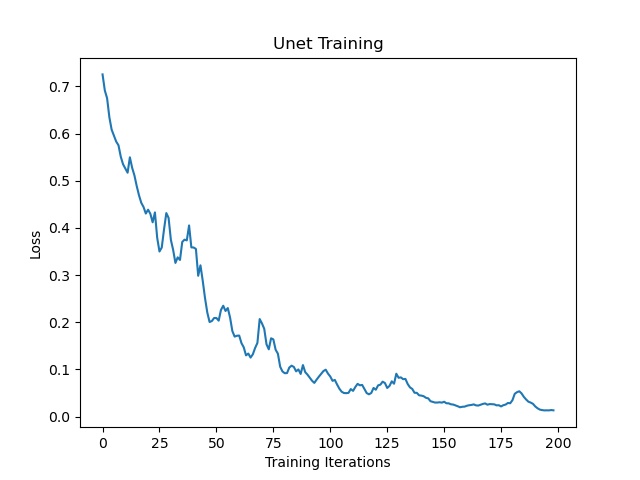
Run classification on test set
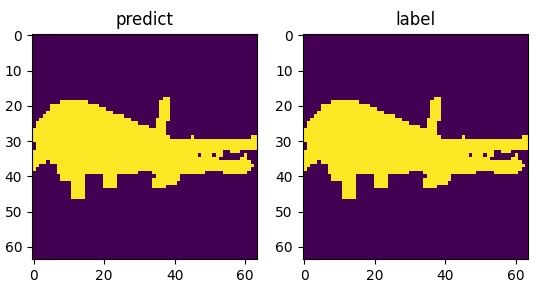
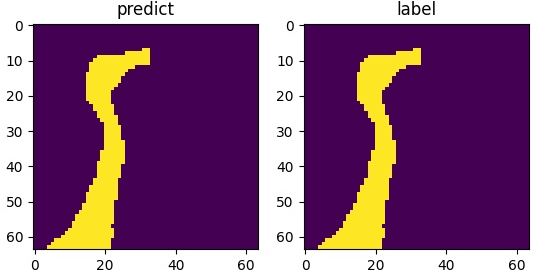
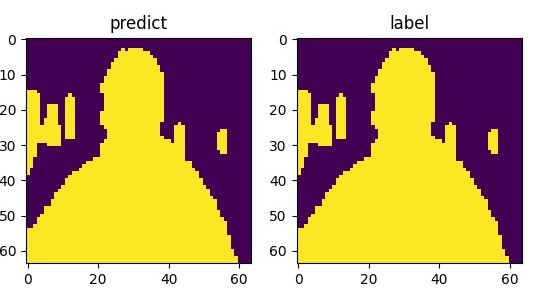
4.Hybrid quantum-classical QCNN network model
We introduce and analyze a novel quantum machine learning model powered by convolutional neural networks. Quantum Convolutional Neural Networks is an algorithm for solving classical image classification. We will write a simple example of integrating pyQPanda with VQNet.
Building Hybrid Classical-Quantum Neural Networks
import random
import numpy as np
import pyqpanda as pq
from qiskit.utils import algorithm_globals
from pyvqnet.qnn.measure import expval
from scipy.optimize import minimize
from abc import abstractmethod
from sklearn.model_selection import train_test_split
from sklearn.base import ClassifierMixin
import matplotlib.pyplot as plt
import matplotlib
try:
    matplotlib.use("TkAgg")
except:  #pylint:disable=bare-except
    print("Can not use matplot TkAgg")

def network(input_data, weights):
    datasets = np.array(input_data)
    number_of_qubits = 8
    circuit_data = []
    for x in datasets:
        machine = pq.CPUQVM()
        machine.init_qvm()
        qlist = machine.qAlloc_many(number_of_qubits)
        clist = machine.cAlloc_many(number_of_qubits)

        circuit = pq.QCircuit()
        circuit.insert(build_VQNet_cir(qlist, number_of_qubits, x, weights))

        prog = pq.QProg()
        prog.insert(circuit)

        pauli_dict = {'Z7': 1}
        exp2 = expval(machine, prog, pauli_dict, qlist)
        circuit_data.append([exp2])

    output = np.array(circuit_data).reshape([-1, 1])

    return output

class ObjectiveFunction:
    # pylint: disable=invalid-name
    def __init__(
        self, X: np.ndarray, y: np.ndarray, neural_network
    ) -> None:
        """
        Args:
            X: The input data.
            y: The target values.
            neural_network: An instance of an quantum neural network to be used by this
                objective function.
        """
        super().__init__()
        self._X = X
        self._num_samples = X.shape[0]
        self._y = y
        self._neural_network = neural_network
        self._last_forward_weights = None
        self._last_forward = None
        self._loss_result = []

    @abstractmethod
    def objective(self, weights: np.ndarray) -> float:
        """Computes the value of this objective function given weights.

        Args:
            weights: an array of weights to be used in the objective function.

        Returns:
            Value of the function.
        """
        raise NotImplementedError

    @abstractmethod
    def gradient(self, weights: np.ndarray) -> np.ndarray:
        """Computes gradients of this objective function given weights.

        Args:
            weights: an array of weights to be used in the objective function.

        Returns:
            Gradients of the function.
        """
        raise NotImplementedError

    def _neural_network_forward(self, weights: np.ndarray):
        """
        Computes and caches the results of the forward pass. Cached values may be re-used in
        gradient computation.

        Args:
            weights: an array of weights to be used in the forward pass.

        Returns:
            The result of the neural network.
        """
        # if we get the same weights, we don't compute the forward pass again.
        if self._last_forward_weights is None or (
            not np.all(np.isclose(weights, self._last_forward_weights))
        ):
            # compute forward and cache the results for re-use in backward
            self._last_forward = self._neural_network(self._X, weights)
            # a copy avoids keeping a reference to the same array, so we are sure we have
            # different arrays on the next iteration.
            self._last_forward_weights = np.copy(weights)
        return self._last_forward

    def _neural_network_backward(self, weights: np.ndarray):

        datasetsy = np.array(self._y)
        datasetsy = datasetsy.reshape([-1, 1])

        weights1 = weights + np.pi / 2
        weights2 = weights - np.pi / 2
        exp1 = self._neural_network_forward(weights1)
        exp2 = self._neural_network_forward(weights2)

        circuit_grad = (exp1 - exp2) / 2
        output = self._neural_network_forward(weights)
        result = 2 * (output - datasetsy)
        grad = result[:, 0] @ circuit_grad
        grad = grad.reshape(1, -1) / self._X.shape[0]
        return grad

class BinaryObjectiveFunction(ObjectiveFunction):
    """An objective function for binary representation of the output,
    e.g. classes of ``-1`` and ``+1``."""

    def objective(self, weights: np.ndarray) -> float:
        # predict is of shape (N, 1), where N is a number of samples
        output = self._neural_network_forward(weights)
        datasetsy = np.array(self._y).reshape([-1, 1])
        if len(output.shape) <= 1:
            loss_data = (output - datasetsy) ** 2
        else:
            loss_data = np.linalg.norm(output - datasetsy, axis=tuple(range(1, len(output.shape)))) ** 2

        result = float(np.sum(loss_data) / self._X.shape[0])
        self._loss_result.append(result)
        return np.average(np.array(result))

    def gradient(self, weights: np.ndarray) -> np.ndarray:
        # weight grad is of shape (N, 1, num_weights)
        weight_grad = self._neural_network_backward(weights)
        return weight_grad

    def loss_value(self):
        # get loss curve data
        return self._loss_result

class VQNet_QCNN(ClassifierMixin):
    def __init__(self, forward_func=None, init_weight=None, optimizer=None):
        """
        forward_func: An instance of an quantum neural network.
        init_weight: Initial weight for the optimizer to start from.
        optimizer: An instance of an optimizer to be used in training. When `None` defaults to L-BFGS-B.
        """
        self.init_weight = init_weight
        self._fit_result = None
        self._forward_func = forward_func
        self._optimizer = optimizer
        self._loss_result = []


    def fit(self, X: np.ndarray, y: np.ndarray): # pylint: disable=invalid-name
        """
        Function operation to solve the optimal solution.
        """
        function = BinaryObjectiveFunction(X, y, self._forward_func)
        self._fit_result = minimize(fun=function.objective, x0=self.init_weight,
                                    method=self._optimizer, jac=function.gradient)
        self._loss_result.append(function.loss_value())
        return self._fit_result.x

    def predict(self, X:np.ndarray):
        """
        Predict
        """
        if self._fit_result is None:
            raise Exception("Model needs to be fit to some training data first!")

        return np.sign(self._forward_func(X, self._fit_result.x))

    # pylint: disable=invalid-name
    def score(
        self, X: np.ndarray, y: np.ndarray, sample_weight=None
    ) -> float:
        """
        Calculate the score.
        """
        result_score = ClassifierMixin.score(self, X, y, sample_weight)
        return result_score

    def get_loss_value(self):
        """
        Get loss curve data.
        """
        result = self._loss_result
        return result

def ZFeatureMap_VQNet(qlist, n_qbits, weights):
    r"""The first order Pauli Z-evolution circuit.
    On 3 qubits and with 2 repetitions the circuit is represented by:

    .. parsed-literal::
        ┌───┐┌──────────────┐┌───┐┌──────────────┐
        ┤ H ├┤ U1(2.0*x[0]) ├┤ H ├┤ U1(2.0*x[0]) ├
        ├───┤├──────────────┤├───┤├──────────────┤
        ┤ H ├┤ U1(2.0*x[1]) ├┤ H ├┤ U1(2.0*x[1]) ├
        ├───┤├──────────────┤├───┤├──────────────┤
        ┤ H ├┤ U1(2.0*x[2]) ├┤ H ├┤ U1(2.0*x[2]) ├
        └───┘└──────────────┘└───┘└──────────────┘

    """
    circuit = pq.QCircuit()
    for i in range(n_qbits):
        circuit.insert(pq.H(qlist[i]))
        circuit.insert(pq.U1(qlist[i], 2.0*weights[i]))
        circuit.insert(pq.H(qlist[i]))
        circuit.insert(pq.U1(qlist[i], 2.0*weights[i]))
    return circuit

def conv_circuit_VQNet(qlist, n_qbits, weights):
    """
    Quantum Convolutional
    """
    circuit = pq.QCircuit()
    circuit.insert(pq.RZ(qlist[1], -np.pi))
    circuit.insert(pq.CNOT(qlist[1], qlist[0]))
    circuit.insert(pq.RZ(qlist[0], weights[0]))
    circuit.insert(pq.RY(qlist[1], weights[1]))
    circuit.insert(pq.CNOT(qlist[0], qlist[1]))
    circuit.insert(pq.RY(qlist[1], weights[2]))
    circuit.insert(pq.CNOT(qlist[1], qlist[0]))
    circuit.insert(pq.RZ(qlist[0], np.pi))
    return circuit

def conv_layer_VQNet(qlist, n_qbits, weights):
    """
     Define the Convolutional Layers of our QCNN
    """
    qubits = list(range(n_qbits))
    param_index = 0
    cir = pq.QCircuit()

    for q1, q2 in zip(qubits[0::2], qubits[1::2]):
        qlist_q = [qlist[q1], qlist[q2]]
        cir.insert(conv_circuit_VQNet(qlist_q, n_qbits, weights[param_index:(param_index + 3)]))
        cir.insert(pq.BARRIER(qlist))
        param_index += 3

    for q1, q2 in zip(qubits[1::2], qubits[2::2] + [0]):
        qlist_q = [qlist[q1], qlist[q2]]
        cir.insert(conv_circuit_VQNet(qlist_q, n_qbits, weights[param_index:(param_index + 3)]))
        cir.insert(pq.BARRIER(qlist))
        param_index += 3

    return cir

def pool_circuit_VQNet(qlist, n_qbits, weights):
    """
    Quantum Pool
    """
    cir = pq.QCircuit()
    cir.insert(pq.RZ(qlist[1], -np.pi))
    cir.insert(pq.CNOT(qlist[1], qlist[0]))
    cir.insert(pq.RZ(qlist[0], weights[0]))
    cir.insert(pq.RY(qlist[1], weights[1]))
    cir.insert(pq.CNOT(qlist[0], qlist[1]))
    cir.insert(pq.RY(qlist[1], weights[2]))

    return cir

def pool_layer_VQNet(sources, sinks, qlist, n_qbits, weights):
    """
    Create a QCNN Pooling Layer
    """
    num_qubits = len(sources) + len(sinks)
    if num_qubits != n_qbits:
        raise ValueError("the number of qubits is error!")
    param_index = 0
    cir = pq.QCircuit()
    for source, sink in zip(sources, sinks):
        qlist_q = [qlist[source], qlist[sink]]
        cir.insert(pool_circuit_VQNet(qlist_q, n_qbits, weights[param_index:(param_index + 3)]))
        cir.insert(pq.BARRIER(qlist))
        param_index += 3

    return cir

def build_VQNet_cir(qubits, n_qbits, input_data, weights):
    """
    Create a VQNet Quantum Convolutional Neural Network.
    """
    circuit = pq.QCircuit()
    circuit.insert(ZFeatureMap_VQNet(qubits, n_qbits, input_data))
    circuit.insert(conv_layer_VQNet(qubits, n_qbits, weights))
    sources = [0, 1, 2, 3]
    sinks = [4, 5, 6, 7]
    circuit.insert(pool_layer_VQNet(sources, sinks, qubits, n_qbits, weights))

    qubits_select_4_8 = qubits[4:8]
    n_qbits_len_4_8 = len(qubits_select_4_8)
    circuit.insert(conv_layer_VQNet(qubits_select_4_8, n_qbits_len_4_8, weights))
    sources = [0, 1]
    sinks = [2, 3]
    circuit.insert(pool_layer_VQNet(sources, sinks, qubits_select_4_8, n_qbits_len_4_8, weights))

    qubits_select_6_8 = qubits[6:8]
    n_qbits_len_6_8 = len(qubits_select_6_8)
    circuit.insert(conv_layer_VQNet(qubits_select_6_8, n_qbits_len_6_8, weights))
    sources = [0]
    sinks = [1]
    circuit.insert(pool_layer_VQNet(sources, sinks, qubits_select_6_8, n_qbits_len_6_8, weights))

    return circuit

def generate_dataset(num_images):
    images = []
    labels = []
    hor_array = np.zeros((6, 8))
    ver_array = np.zeros((4, 8))

    j = 0
    for i in range(0, 7):
        if i != 3:
            hor_array[j][i] = np.pi / 2
            hor_array[j][i + 1] = np.pi / 2
            j += 1

    j = 0
    for i in range(0, 4):
        ver_array[j][i] = np.pi / 2
        ver_array[j][i + 4] = np.pi / 2
        j += 1

    for n in range(num_images):
        rng = algorithm_globals.random.integers(0, 2)
        if rng == 0:
            labels.append(-1)
            random_image = algorithm_globals.random.integers(0, 6)
            images.append(np.array(hor_array[random_image]))
        elif rng == 1:
            labels.append(1)
            random_image = algorithm_globals.random.integers(0, 4)
            images.append(np.array(ver_array[random_image]))

        # Create noise
        for i in range(8):
            if images[-1][i] == 0:
                images[-1][i] = algorithm_globals.random.uniform(0, np.pi / 4)
    return images, labels

def vqnet_qcnn_test():
    algorithm_globals.random_seed = 12345
    random.seed(24)

    images, labels = generate_dataset(50)

    train_images, test_images, train_labels, test_labels = train_test_split(
        images, labels, test_size=0.3
    )

    fig, ax = plt.subplots(2, 2, figsize=(10, 6), subplot_kw={"xticks": [], "yticks": []})
    for i in range(4):
        ax[i // 2, i % 2].imshow(
            train_images[i].reshape(2, 4),  # Change back to 2 by 4
            aspect="equal",
        )
    plt.subplots_adjust(wspace=0.1, hspace=0.025)
    # plt.show()

    _initial_point = algorithm_globals.random.random(63)
    qcnn_compute = VQNet_QCNN(forward_func=network, init_weight=_initial_point, optimizer="COBYLA")
    x = np.asarray(train_images)
    y = np.asarray(train_labels)
    result = qcnn_compute.fit(x, y)
    print(len(result))

    # score classifier
    print(f"Accuracy from the train data : {np.round(100 * qcnn_compute.score(x, y), 2)}%")

    # show the loss
    plt.figure()
    loss_value = qcnn_compute.get_loss_value()[0]
    loss_len = len(loss_value)
    x = np.arange(1, loss_len+1)
    plt.plot(x, loss_value, "b")
    plt.show()


if __name__ == "__main__":
    vqnet_qcnn_test()
data result
The loss function curve of the training data is displayed and saved, and the results of the test data are saved. Loss situation on the training set
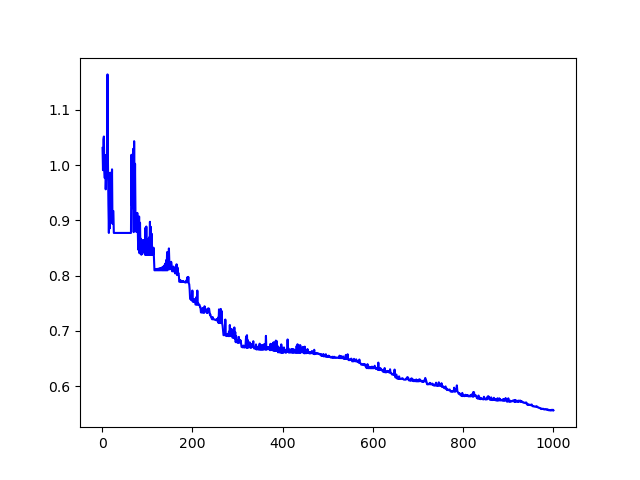
Visualize the operation
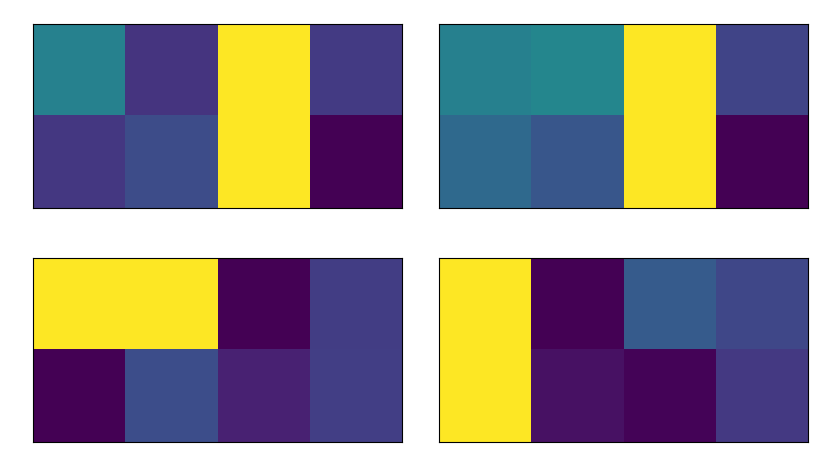
5.Hybrid quantum-classical QMLP network model
We introduce and analyze a proposed quantum multilayer perceptron (QMLP) architecture featuring fault-tolerant input embeddings, rich nonlinearities, and enhanced variational circuit simulations with parameterized two-qubit entanglement gates. QMLP: An Error-Tolerant Nonlinear Quantum MLP Architecture using Parameterized Two-Qubit Gates . We will write a simple example of integrating pyQPanda with VQNet.
Building Hybrid Classical-Quantum Neural Networks
import os
import gzip
import struct
import numpy as np
import pyqpanda as pq
from pyvqnet.nn.module import Module
from pyvqnet.nn.loss import MeanSquaredError, CrossEntropyLoss
from pyvqnet.optim.adam import Adam
from pyvqnet.tensor.tensor import QTensor
from pyvqnet.qnn.measure import expval
from pyvqnet.qnn.quantumlayer import QuantumLayer, QuantumLayerMultiProcess
from pyvqnet.nn.pooling import AvgPool2D
from pyvqnet.nn.linear import Linear
from pyvqnet.data.data import data_generator
from pyvqnet.tensor import tensor
import matplotlib
from matplotlib import pyplot as plt
try:
    matplotlib.use("TkAgg")
except:  # pylint:disable=bare-except
    print("Can not use matplot TkAgg")

try:
    import urllib.request
except ImportError:
    raise ImportError("You should use Python 3.x")

url_base = "http://yann.lecun.com/exdb/mnist/"
key_file = {
    "train_img": "train-images-idx3-ubyte.gz",
    "train_label": "train-labels-idx1-ubyte.gz",
    "test_img": "t10k-images-idx3-ubyte.gz",
    "test_label": "t10k-labels-idx1-ubyte.gz"
}


def _download(dataset_dir, file_name):
    """
    Download mnist data if needed.
    """
    file_path = dataset_dir + "/" + file_name

    if os.path.exists(file_path):
        with gzip.GzipFile(file_path) as file:
            file_path_ungz = file_path[:-3].replace("\\", "/")
            if not os.path.exists(file_path_ungz):
                open(file_path_ungz, "wb").write(file.read())
        return

    print("Downloading " + file_name + " ... ")
    urllib.request.urlretrieve(url_base + file_name, file_path)
    if os.path.exists(file_path):
        with gzip.GzipFile(file_path) as file:
            file_path_ungz = file_path[:-3].replace("\\", "/")
            file_path_ungz = file_path_ungz.replace("-idx", ".idx")
            if not os.path.exists(file_path_ungz):
                open(file_path_ungz, "wb").write(file.read())
    print("Done")

def download_mnist(dataset_dir):
    for v in key_file.values():
        _download(dataset_dir, v)

def load_mnist(dataset="training_data", digits=np.arange(2), path="./"):
    """
    load mnist data
    """
    from array import array as pyarray
    download_mnist(path)
    if dataset == "training_data":
        fname_image = os.path.join(path, "train-images.idx3-ubyte").replace(
            "\\", "/")
        fname_label = os.path.join(path, "train-labels.idx1-ubyte").replace(
            "\\", "/")
    elif dataset == "testing_data":
        fname_image = os.path.join(path, "t10k-images.idx3-ubyte").replace(
            "\\", "/")
        fname_label = os.path.join(path, "t10k-labels.idx1-ubyte").replace(
            "\\", "/")
    else:
        raise ValueError("dataset must be 'training_data' or 'testing_data'")

    flbl = open(fname_label, "rb")
    _, size = struct.unpack(">II", flbl.read(8))
    lbl = pyarray("b", flbl.read())
    flbl.close()

    fimg = open(fname_image, "rb")
    _, size, rows, cols = struct.unpack(">IIII", fimg.read(16))
    img = pyarray("B", fimg.read())
    fimg.close()

    ind = [k for k in range(size) if lbl[k] in digits]
    num = len(ind)
    images = np.zeros((num, rows, cols))
    labels = np.zeros((num, 1), dtype=int)
    for i in range(len(ind)):
        images[i] = np.array(img[ind[i] * rows * cols:(ind[i] + 1) * rows *
                                 cols]).reshape((rows, cols))
        labels[i] = lbl[ind[i]]

    return images, labels

def data_select(train_num, test_num):
    """
    Select data from mnist dataset.
    """
    x_train, y_train = load_mnist("training_data")  #pylint:disable=redefined-outer-name
    x_test, y_test = load_mnist("testing_data")  #pylint:disable=redefined-outer-name
    idx_train = np.append(
        np.where(y_train == 0)[0][:train_num],
        np.where(y_train == 1)[0][:train_num])

    x_train = x_train[idx_train]
    y_train = y_train[idx_train]

    x_train = x_train / 255
    y_train = np.eye(2)[y_train].reshape(-1, 2)

    # Test Leaving only labels 0 and 1
    idx_test = np.append(
        np.where(y_test == 0)[0][:test_num],
        np.where(y_test == 1)[0][:test_num])

    x_test = x_test[idx_test]
    y_test = y_test[idx_test]
    x_test = x_test / 255
    y_test = np.eye(2)[y_test].reshape(-1, 2)

    return x_train, y_train, x_test, y_test

def RotCircuit(para, qlist):
    r"""

    Arbitrary single qubit rotation.Number of qlist should be 1,and number of parameters should
    be 3

    .. math::

        R(\phi,\theta,\omega) = RZ(\omega)RY(\theta)RZ(\phi)= \begin{bmatrix}
        e^{-i(\phi+\omega)/2}\cos(\theta/2) & -e^{i(\phi-\omega)/2}\sin(\theta/2) \\
        e^{-i(\phi-\omega)/2}\sin(\theta/2) & e^{i(\phi+\omega)/2}\cos(\theta/2)
        \end{bmatrix}.


    :param para: numpy array which represents paramters [\phi, \theta, \omega]
    :param qlist: qubits allocated by pyQpanda.qAlloc_many()
    :return: quantum circuits

    Example::

        m_machine = pq.init_quantum_machine(pq.QMachineType.CPU)
        m_clist = m_machine.cAlloc_many(2)
        m_prog = pq.QProg()
        m_qlist = m_machine.qAlloc_many(1)
        param = np.array([3,4,5])
        c = RotCircuit(param,m_qlist)
        print(c)
        pq.destroy_quantum_machine(m_machine)

    """
    if isinstance(para, QTensor):
        para = QTensor._to_numpy(para)
    if para.ndim > 1:
        raise ValueError(" dim of paramters in Rot should be 1")
    if para.shape[0] != 3:
        raise ValueError(" numbers of paramters in Rot should be 3")

    cir = pq.QCircuit()
    cir.insert(pq.RZ(qlist, para[2]))
    cir.insert(pq.RY(qlist, para[1]))
    cir.insert(pq.RZ(qlist, para[0]))

    return cir

def build_RotCircuit(qubits, weights):
    cir = pq.QCircuit()
    cir.insert(RotCircuit(weights[0:3], qubits[0]))
    cir.insert(RotCircuit(weights[3:6], qubits[1]))
    cir.insert(RotCircuit(weights[6:9], qubits[2]))
    cir.insert(RotCircuit(weights[9:12], qubits[3]))
    cir.insert(RotCircuit(weights[12:15], qubits[4]))
    cir.insert(RotCircuit(weights[15:18], qubits[5]))
    cir.insert(RotCircuit(weights[18:21], qubits[6]))
    cir.insert(RotCircuit(weights[21:24], qubits[7]))
    cir.insert(RotCircuit(weights[24:27], qubits[8]))
    cir.insert(RotCircuit(weights[27:30], qubits[9]))
    cir.insert(RotCircuit(weights[30:33], qubits[10]))
    cir.insert(RotCircuit(weights[33:36], qubits[11]))
    cir.insert(RotCircuit(weights[36:39], qubits[12]))
    cir.insert(RotCircuit(weights[39:42], qubits[13]))
    cir.insert(RotCircuit(weights[42:45], qubits[14]))
    cir.insert(RotCircuit(weights[45:48], qubits[15]))

    return cir

def CRXCircuit(para, control_qlists, rot_qlists):
    cir = pq.QCircuit()
    cir.insert(pq.RX(rot_qlists, para))
    cir.set_control(control_qlists)
    return cir

def build_CRotCircuit(qubits, weights):
    cir = pq.QCircuit()
    cir.insert(CRXCircuit(weights[0], qubits[0], qubits[1]))
    cir.insert(CRXCircuit(weights[1], qubits[1], qubits[2]))
    cir.insert(CRXCircuit(weights[2], qubits[2], qubits[3]))
    cir.insert(CRXCircuit(weights[3], qubits[3], qubits[4]))
    cir.insert(CRXCircuit(weights[4], qubits[4], qubits[5]))
    cir.insert(CRXCircuit(weights[5], qubits[5], qubits[6]))
    cir.insert(CRXCircuit(weights[6], qubits[6], qubits[7]))
    cir.insert(CRXCircuit(weights[7], qubits[7], qubits[8]))
    cir.insert(CRXCircuit(weights[8], qubits[8], qubits[9]))
    cir.insert(CRXCircuit(weights[9], qubits[9], qubits[10]))
    cir.insert(CRXCircuit(weights[10], qubits[10], qubits[11]))
    cir.insert(CRXCircuit(weights[11], qubits[11], qubits[12]))
    cir.insert(CRXCircuit(weights[12], qubits[12], qubits[13]))
    cir.insert(CRXCircuit(weights[13], qubits[13], qubits[14]))
    cir.insert(CRXCircuit(weights[14], qubits[14], qubits[15]))
    cir.insert(CRXCircuit(weights[15], qubits[15], qubits[0]))

    return cir


def build_qmlp_circuit(x, weights, qubits, clist, machine):
    cir = pq.QCircuit()
    num_qubits = len(qubits)
    for i in range(num_qubits):
        cir.insert(pq.RX(qubits[i], x[i]))

    cir.insert(build_RotCircuit(qubits, weights[0:48]))
    cir.insert(build_CRotCircuit(qubits, weights[48:64]))

    for i in range(num_qubits):
        cir.insert(pq.RX(qubits[i], x[i]))

    cir.insert(build_RotCircuit(qubits, weights[64:112]))
    cir.insert(build_CRotCircuit(qubits, weights[112:128]))

    prog = pq.QProg()
    prog.insert(cir)
    # print(prog)
    # exit()

    exp_vals = []
    for position in range(num_qubits):
        pauli_str = {"Z" + str(position): 1.0}
        exp2 = expval(machine, prog, pauli_str, qubits)
        exp_vals.append(exp2)

    return exp_vals

def build_multiprocess_qmlp_circuit(x, weights, num_qubits, num_clist):
    machine = pq.CPUQVM()
    machine.init_qvm()
    qubits = machine.qAlloc_many(num_qubits)
    cir = pq.QCircuit()
    for i in range(num_qubits):
        cir.insert(pq.RX(qubits[i], x[i]))

    cir.insert(build_RotCircuit(qubits, weights[0:48]))
    cir.insert(build_CRotCircuit(qubits, weights[48:64]))

    for i in range(num_qubits):
        cir.insert(pq.RX(qubits[i], x[i]))

    cir.insert(build_RotCircuit(qubits, weights[64:112]))
    cir.insert(build_CRotCircuit(qubits, weights[112:128]))

    prog = pq.QProg()
    prog.insert(cir)
    # print(prog)
    # exit()

    exp_vals = []
    for position in range(num_qubits):
        pauli_str = {"Z" + str(position): 1.0}
        exp2 = expval(machine, prog, pauli_str, qubits)
        exp_vals.append(exp2)

    return exp_vals

class QMLPModel(Module):
    def __init__(self):
        super(QMLPModel, self).__init__()
        self.ave_pool2d = AvgPool2D([7, 7], [7, 7], "valid")
        # self.quantum_circuit = QuantumLayer(build_qmlp_circuit, 128, "CPU", 16, diff_method="finite_diff")
        self.quantum_circuit = QuantumLayerMultiProcess(build_multiprocess_qmlp_circuit, 128, "CPU",
                                                        16, 1, diff_method="finite_diff")
        self.linear = Linear(16, 10)

    def forward(self, x):
        bsz = x.shape[0]
        x = self.ave_pool2d(x)
        input_data = x.reshape([bsz, 16])
        quanutum_result = self.quantum_circuit(input_data)
        result = self.linear(quanutum_result)
        return result

def vqnet_test_QMLPModel():
    # train num=1000, test_num=100
    # x_train, y_train, x_test, y_test = data_select(1000, 100)

    train_size = 1000
    eval_size = 100
    x_train, y_train = load_mnist("training_data", digits=np.arange(10))
    x_test, y_test = load_mnist("testing_data", digits=np.arange(10))

    x_train = x_train[:train_size]
    y_train = y_train[:train_size]
    x_test = x_test[:eval_size]
    y_test = y_test[:eval_size]

    x_train = x_train / 255
    x_test = x_test / 255
    y_train = np.eye(10)[y_train].reshape(-1, 10)
    y_test = np.eye(10)[y_test].reshape(-1, 10)

    model = QMLPModel()
    optimizer = Adam(model.parameters(), lr=0.005)
    loss_func = CrossEntropyLoss()
    loss_list = []
    epochs = 30
    for epoch in range(1, epochs):
        total_loss = []

        correct = 0
        n_train = 0
        for x, y in data_generator(x_train,
                                   y_train,
                                   batch_size=16,
                                   shuffle=True):

            x = x.reshape(-1, 1, 28, 28)
            optimizer.zero_grad()
            # Forward pass
            output = model(x)
            # Calculating loss
            loss = loss_func(y, output)
            loss_np = np.array(loss.data)
            print("loss: ", loss_np)
            np_output = np.array(output.data, copy=False)

            temp_out = np_output.argmax(axis=1)
            temp_output = np.zeros((temp_out.size, 10))
            temp_output[np.arange(temp_out.size), temp_out] = 1
            temp_maks = (temp_output == y)

            correct += np.sum(np.array(temp_maks))
            n_train += 160

            # Backward pass
            loss.backward()
            # Optimize the weights
            optimizer._step()
            total_loss.append(loss_np)
        print("##########################")
        print(f"Train Accuracy: {correct / n_train}")
        loss_list.append(np.sum(total_loss) / len(total_loss))
        # train_acc_list.append(correct / n_train)
        print("epoch: ", epoch)
        # print(100. * (epoch + 1) / epochs)
        print("{:.0f} loss is : {:.10f}".format(epoch, loss_list[-1]))

if __name__ == "__main__":

    vqnet_test_QMLPModel()
data result
The loss function curve of the training data is displayed and saved, and the results of the test data are saved. Loss situation on the training set
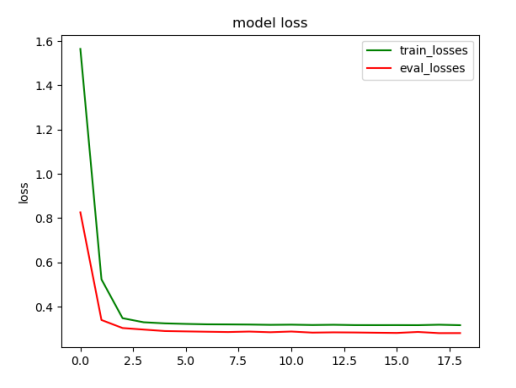
Unsupervised learning
1 Quantum Kmeans
1.1 Introduction
Clustering algorithm is a typical unsupervised learning algorithm, which is mainly used to automatically classify similar samples into one class. In the clustering algorithm, samples are divided into different categories according to the similarity between samples. For different similarity calculation methods, different clustering results will be obtained. The common similarity calculation method is Euclidean distance method. What we want to show is the quantum k-means algorithm. K-means algorithm is a distance based clustering algorithm. It takes distance as the evaluation index of similarity, that is, the closer the distance between two objects, the greater the similarity. The algorithm considers that clusters are composed of objects close to each other, so compact and independent clusters are the ultimate goal.
Quantum kmeans quantum machine learning model can also be developed in VQNet. An example of the quantum kmeans clustering task is given below. Through the quantum circuit, we can construct a measurement that is positively correlated with the Euclidean distance of the variables of classical machine learning, so as to achieve the goal of finding the nearest neighbor.
1.2 Introduction to algorithm principle
The implementation of quantum k-means algorithm mainly uses swap test to compare the distance between input data points. Randomly select k points from N data points as centroids, measure the distance from each point to each centroid, assign it to the nearest centroid class, recalculate the centroid of each class, and iterate 2 to 3 steps until the new centroid is equal to or less than the specified threshold. In our example, we select 100 data points and 2 centroids, and use cswap circuit to calculate the distance. Finally, we obtained two data point clusters. \(|0\rangle\) is an auxiliary bit, through the H logic gate, the qubit will become \(\frac{1}{\sqrt{2}}(|0\rangle + |1\rangle)\). Under the control of \(|1\rangle\) qubit, The quantum circuit will flip \(|x\rangle\) and \(|y\rangle\) . Finally get the result:
If we measure the auxiliary qubit separately, the probability of the final state of the ground state \(|1\rangle\) is:
The Euclidean distance between two quantum states is as follows:
Visible measurement qubit \(|1\rangle\) is positively correlated with Euclidean distance. The quantum circuit of this algorithm is as follows:
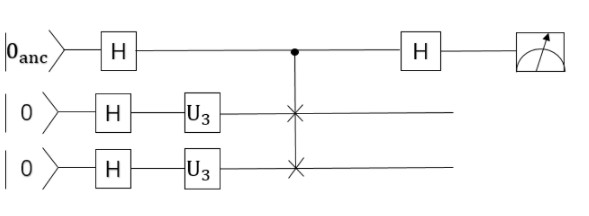
1.3 VQNet implementation
1.3.1 Environmental preparation
The environment adopts Python 3 8. It is recommended to use CONDA for environment configuration. It comes with numpy, SciPy, Matplotlib, sklearn and other toolkits for easy use. If the python environment is adopted, relevant packages need to be installed, and the following environment pyvqnet needs to be prepared
1.3.2 Data preparation
The data is randomly generated by make_blobs under SciPy, and the function is defined to generate Gaussian distribution data.
import math
import numpy as np
from pyvqnet.tensor import QTensor, zeros
import pyvqnet.tensor as tensor
import pyqpanda as pq
from sklearn.datasets import make_blobs
import matplotlib.pyplot as plt
import matplotlib
try:
    matplotlib.use("TkAgg")
except:  #pylint:disable=bare-except
    print("Can not use matplot TkAgg")
    pass
# According to the data amount n of the data, the cluster center K and the data standard deviation std return the corresponding data point and the cluster center point
def get_data(n, k, std):
    data = make_blobs(n_samples=n, n_features=2, centers=k, cluster_std=std, random_state=100)
    points = data[0]
    centers = data[1]
    return points, centers
1.3.3 Quantum circuit
Constructing quantum circuits using VQNet
# The input quantum gate rotation angle is calculated according to the input coordinate point d (x, y)
def get_theta(d):
    x = d[0]
    y = d[1]
    theta = 2 * math.acos((x.item() + y.item()) / 2.0)
    return theta

# The quantum circuit is constructed according to the input quantum data points
def qkmeans_circuits(x, y):

    theta_1 = get_theta(x)
    theta_2 = get_theta(y)

    num_qubits = 3
    machine = pq.CPUQVM()
    machine.init_qvm()
    qubits = machine.qAlloc_many(num_qubits)
    cbits = machine.cAlloc_many(num_qubits)
    circuit = pq.QCircuit()

    circuit.insert(pq.H(qubits[0]))
    circuit.insert(pq.H(qubits[1]))
    circuit.insert(pq.H(qubits[2]))

    circuit.insert(pq.U3(qubits[1], theta_1, np.pi, np.pi))
    circuit.insert(pq.U3(qubits[2], theta_2, np.pi, np.pi))

    circuit.insert(pq.SWAP(qubits[1], qubits[2]).control([qubits[0]]))

    circuit.insert(pq.H(qubits[0]))

    prog = pq.QProg()
    prog.insert(circuit)
    prog << pq.Measure(qubits[0], cbits[0])
    prog.insert(pq.Reset(qubits[0]))
    prog.insert(pq.Reset(qubits[1]))
    prog.insert(pq.Reset(qubits[2]))

    result = machine.run_with_configuration(prog, cbits, 1024)

    data = result

    if len(data) == 1:
        return 0.0
    else:
        return data['001'] / 1024.0
1.3.4 Data visualization
Visual calculation of relevant clustering data
# Visualization of scatter points and cluster centers
def draw_plot(points, centers, label=True):
    points = np.array(points)
    centers = np.array(centers)
    if label==False:
        plt.scatter(points[:,0], points[:,1])
    else:
        plt.scatter(points[:,0], points[:,1], c=centers, cmap='viridis')
    plt.xlim(0, 1)
    plt.ylim(0, 1)
    plt.show()
1.3.5 Cluster calculation
Calculate the cluster center of relevant cluster data
# Randomly generate cluster center points
def initialize_centers(points,k):
    return points[np.random.randint(points.shape[0],size=k),:]


def find_nearest_neighbour(points, centroids):
    n = points.shape[0]
    k = centroids.shape[0]

    centers = zeros([n])

    for i in range(n):
        min_dis = 10000
        ind = 0
        for j in range(k):

            temp_dis = qkmeans_circuits(points[i, :], centroids[j, :])

            if temp_dis < min_dis:
                min_dis = temp_dis
                ind = j
        centers[i] = ind

    return centers

def find_centroids(points, centers):

    k = int(tensor.max(centers).item()) + 1
    centroids = tensor.zeros([k, 2])
    for i in range(k):

        cur_i = centers == i

        x = points[:,0]
        x = x[cur_i]
        y = points[:,1]
        y = y[cur_i]
        centroids[i, 0] = tensor.mean(x)
        centroids[i, 1] = tensor.mean(y)

    return centroids

def preprocess(points):
    n = len(points)
    x = 30.0 * np.sqrt(2)
    for i in range(n):
        points[i, :] += 15
        points[i, :] /= x

    return points


def qkmean_run():
    n = 100  # number of data points
    k = 3  # Number of centers
    std = 2  # std of datapoints

    points, o_centers = get_data(n, k, std)  # dataset

    points = preprocess(points)  # Normalize dataset

    centroids = initialize_centers(points, k)  # Intialize centroids

    epoch = 9
    points = QTensor(points)
    centroids = QTensor(centroids)
    plt.figure()
    draw_plot(points.data, o_centers,label=False)

    for i in range(epoch):
            centers = find_nearest_neighbour(points, centroids)  # find nearest centers
            centroids = find_centroids(points, centers)  # find centroids

    plt.figure()
    draw_plot(points.data, centers.data)

# Run program entry
if __name__ == "__main__":
    qkmean_run()
1.3.6 Data distribution before clustering
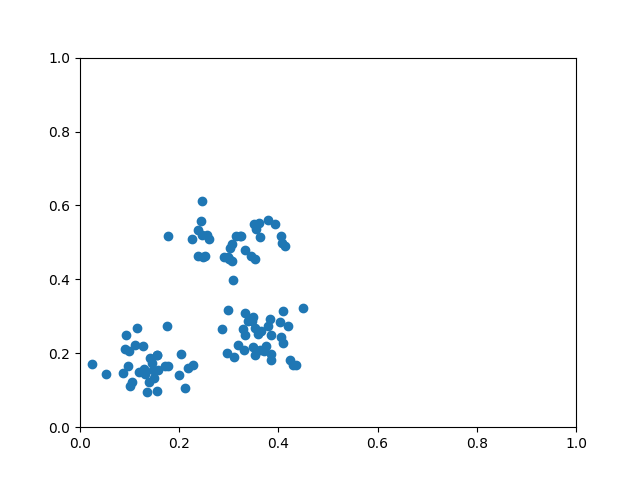
1.3.7 Data distribution after clustering
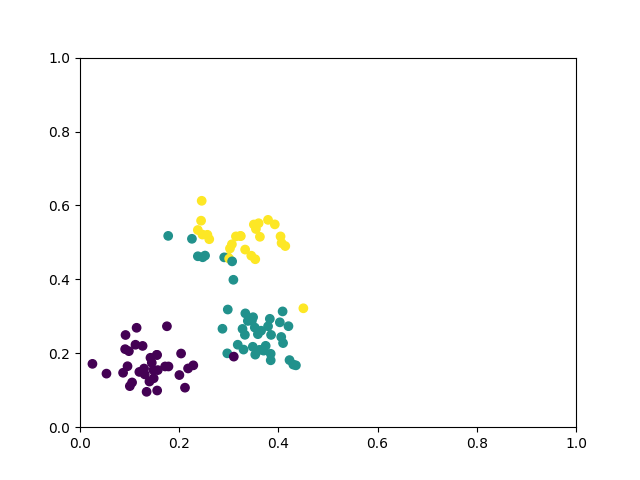
Model training using quantum computing layer in VQNet
The following are some examples of using VQNet inrerface for quantum machine learning QuantumLayer ,NoiseQuantumLayer ,VQCLayer.
Model training using quantumlayer in VQNet
import sys,os
from pyvqnet.nn.module import Module
from pyvqnet.optim import sgd
import numpy as np
import os
from pyvqnet.nn.linear import Linear
from pyvqnet.nn.loss import CategoricalCrossEntropy

from pyvqnet.tensor.tensor import QTensor
import random
import pyqpanda as pq
from pyvqnet.qnn.quantumlayer import QuantumLayer
from pyqpanda import *
random.seed(1234)

qvc_train_data = [0,1,0,0,1,
0, 1, 0, 1, 0,
0, 1, 1, 0, 0,
0, 1, 1, 1, 1,
1, 0, 0, 0, 1,
1, 0, 0, 1, 0,
1, 0, 1, 0, 0,
1, 0, 1, 1, 1,
1, 1, 0, 0, 0,
1, 1, 0, 1, 1,
1, 1, 1, 0, 1,
1, 1, 1, 1, 0]
qvc_test_data= [0, 0, 0, 0, 0,
0, 0, 0, 1, 1,
0, 0, 1, 0, 1,
0, 0, 1, 1, 0]

def qvc_circuits(input,weights,qlist,clist,machine):

    def get_cnot(nqubits):
        cir = pq.QCircuit()
        for i in range(len(nqubits)-1):
            cir.insert(pq.CNOT(nqubits[i],nqubits[i+1]))
        cir.insert(pq.CNOT(nqubits[len(nqubits)-1],nqubits[0]))
        return cir

    def build_circult(weights, xx, nqubits):

        def Rot(weights_j, qubits):
            circult = pq.QCircuit()
            circult.insert(pq.RZ(qubits, weights_j[0]))
            circult.insert(pq.RY(qubits, weights_j[1]))
            circult.insert(pq.RZ(qubits, weights_j[2]))
            return circult
        def basisstate():
            circult = pq.QCircuit()
            for i in range(len(nqubits)):
                if xx[i]==1:
                    circult.insert(pq.X(nqubits[i]))
            return circult

        circult = pq.QCircuit()
        circult.insert(basisstate())

        for i in range(weights.shape[0]):

            weights_i = weights[i,:,:]
            for j in range(len(nqubits)):
                weights_j = weights_i[j]
                circult.insert(Rot(weights_j,nqubits[j]))
            cnots = get_cnot(nqubits)
            circult.insert(cnots)

        circult.insert(pq.Z(nqubits[0]))

        prog = pq.QProg()

        prog.insert(circult)
        return prog

    weights = weights.reshape([2,4,3])
    prog = build_circult(weights,input,qlist)
    prob = machine.prob_run_dict(prog, qlist[0], -1)
    prob = list(prob.values())

    return prob

class Model(Module):
    def __init__(self):
        super(Model, self).__init__()
        self.qvc = QuantumLayer(qvc_circuits,24,"cpu",4)

    def forward(self, x):
        return self.qvc(x)

def dataloader(data,label,batch_size, shuffle = True)->np:
    if shuffle:
        for _ in range(len(data)//batch_size):
            random_index = np.random.randint(0, len(data), (batch_size, 1))
            yield data[random_index].reshape(batch_size,-1),label[random_index].reshape(batch_size,-1)
    else:
        for i in range(0,len(data)-batch_size+1,batch_size):
            yield data[i:i+batch_size], label[i:i+batch_size]

def get_data(dataset_str):
    if dataset_str == "train":
        datasets = np.array(qvc_train_data)

    else:
        datasets = np.array(qvc_test_data)

    datasets = datasets.reshape([-1,5])
    data = datasets[:,:-1]
    label = datasets[:,-1].astype(int)
    label = np.eye(2)[label].reshape(-1,2)
    return data, label

def get_accuary(result,label):
    result,label = np.array(result.data), np.array(label.data)
    score = np.sum(np.argmax(result,axis=1)==np.argmax(label,1))
    return score

def Run():

    model = Model()

    optimizer = sgd.SGD(model.parameters(),lr =0.5)
    batch_size = 3
    epoch = 10
    loss = CategoricalCrossEntropy()
    print("start training..............")
    model.train()

    datas,labels = get_data("train")
    print(datas)
    print(labels)
    print(datas.shape)
    for i in range(epoch):
        count=0
        sum_loss = 0
        accuary = 0
        t = 0
        for data,label in dataloader(datas,labels,batch_size,False):
            optimizer.zero_grad()
            data,label = QTensor(data), QTensor(label)

            result = model(data)

            loss_b = loss(label,result)
            loss_b.backward()
            optimizer._step()
            sum_loss += loss_b.item()
            count+=batch_size
            accuary += get_accuary(result,label)
            t = t + 1

        print(f"epoch:{i}, #### loss:{sum_loss/count} #####accuray:{accuary/count}")
    print("start testing..............")
    model.eval()
    count = 0
    test_data, test_label = get_data("test")
    test_batch_size = 1
    accuary = 0
    sum_loss = 0
    for testd,testl in dataloader(test_data,test_label,test_batch_size):
        testd = QTensor(testd)
        test_result = model(testd)
        test_loss = loss(testl,test_result)
        sum_loss += test_loss
        count+=test_batch_size
        accuary += get_accuary(test_result,testl)
    print(f"test:--------------->loss:{sum_loss/count} #####accuray:{accuary/count}")

if __name__=="__main__":

    Run()
Loss and accuracy results of the run:
start training..............
epoch:0, #### loss:[0.20585182] #####accuray:0.6
epoch:1, #### loss:[0.17479989] #####accuray:1.0
epoch:2, #### loss:[0.12679021] #####accuray:1.0
epoch:3, #### loss:[0.11088503] #####accuray:1.0
epoch:4, #### loss:[0.10598478] #####accuray:1.0
epoch:5, #### loss:[0.10482856] #####accuray:1.0
epoch:6, #### loss:[0.10453037] #####accuray:1.0
epoch:7, #### loss:[0.10445572] #####accuray:1.0
epoch:8, #### loss:[0.10442699] #####accuray:1.0
epoch:9, #### loss:[0.10442187] #####accuray:1.0
epoch:10, #### loss:[0.10442089] #####accuray:1.0
epoch:11, #### loss:[0.10442062] #####accuray:1.0
epoch:12, #### loss:[0.10442055] #####accuray:1.0
epoch:13, #### loss:[0.10442055] #####accuray:1.0
epoch:14, #### loss:[0.10442055] #####accuray:1.0
epoch:15, #### loss:[0.10442055] #####accuray:1.0
epoch:16, #### loss:[0.10442055] #####accuray:1.0

start testing..............
[0.3132616580]
test:--------------->loss:QTensor(None, requires_grad=True) #####accuray:1.0
Model training using NoiseQuantumLayer in VQNet
Using NoiseQuantumLayer to build and train noisy quantum circuits using QPanda’s noise virtual machine.
An example of a complete noisy quantum machine learning model is as follows:
import os
import numpy as np

from pyvqnet.nn.module import Module
from pyvqnet.nn.linear import Linear
from pyvqnet.nn.conv import Conv2D

from pyvqnet.nn import activation as F
from pyvqnet.nn.pooling import MaxPool2D
from pyvqnet.nn.loss import CategoricalCrossEntropy
from pyvqnet.optim.adam import Adam
from pyvqnet.data.data import data_generator
from pyvqnet.tensor import tensor

import pyqpanda as pq
from pyqpanda import *
from pyvqnet.qnn.quantumlayer import NoiseQuantumLayer
import matplotlib
try:
    matplotlib.use('TkAgg')
except:
    pass
import time
try:
    matplotlib.use('TkAgg')
except:
    pass

try:
    import urllib.request
except ImportError:
    raise ImportError('You should use Python 3.x')
import os.path
import gzip

url_base = 'http://yann.lecun.com/exdb/mnist/'
key_file = {
    'train_img':'train-images-idx3-ubyte.gz',
    'train_label':'train-labels-idx1-ubyte.gz',
    'test_img':'t10k-images-idx3-ubyte.gz',
    'test_label':'t10k-labels-idx1-ubyte.gz'
}


def _download(dataset_dir,file_name):
    file_path = dataset_dir + "/" + file_name

    if os.path.exists(file_path):
        with gzip.GzipFile(file_path) as f:
            file_path_ungz = file_path[:-3].replace('\\', '/')
            if not os.path.exists(file_path_ungz):
                open(file_path_ungz,"wb").write(f.read())
        return

    print("Downloading " + file_name + " ... ")
    urllib.request.urlretrieve(url_base + file_name, file_path)
    if os.path.exists(file_path):
            with gzip.GzipFile(file_path) as f:
                file_path_ungz = file_path[:-3].replace('\\', '/')
                file_path_ungz = file_path_ungz.replace('-idx', '.idx')
                if not os.path.exists(file_path_ungz):
                    open(file_path_ungz,"wb").write(f.read())
    print("Done")

def download_mnist(dataset_dir):
    for v in key_file.values():
        _download(dataset_dir,v)

#use qpanda to create quantum circuits
def circuit(weights,param,qubits,cbits,machine):

    circuit = pq.QCircuit()
    circuit.insert(pq.H(qubits[0]))
    circuit.insert(pq.RY(qubits[0], weights[0]))
    prog = pq.QProg()
    prog.insert(circuit)
    prog << measure_all(qubits, cbits)
    result = machine.run_with_configuration(prog, cbits, 100)
    counts = np.array(list(result.values()))
    states = np.array(list(result.keys())).astype(float)
    # Compute probabilities for each state
    probabilities = counts / 100
    # Get state expectation
    expectation = np.sum(states * probabilities)
    return expectation


class Net(Module):
    def __init__(self):
        super(Net, self).__init__()
        self.conv1 = Conv2D(input_channels=1, output_channels=6, kernel_size=(5, 5), stride=(1, 1), padding="valid")
        self.maxpool1 = MaxPool2D([2, 2], [2, 2], padding="valid")
        self.conv2 = Conv2D(input_channels=6, output_channels=16, kernel_size=(5, 5), stride=(1, 1), padding="valid")
        self.maxpool2 = MaxPool2D([2, 2], [2, 2], padding="valid")
        self.fc1 = Linear(input_channels=256, output_channels=64)
        self.fc2 = Linear(input_channels=64, output_channels=1)

        self.hybrid = NoiseQuantumLayer(circuit,1,"noise",1)
        self.fc3 = Linear(input_channels=1, output_channels=2)


    def forward(self, x):
        x = F.ReLu()(self.conv1(x))
        x = self.maxpool1(x)
        x = F.ReLu()(self.conv2(x))
        x = self.maxpool2(x)
        x = tensor.flatten(x, 1)
        x = F.ReLu()(self.fc1(x))
        x = self.fc2(x)
        x = self.hybrid(x)
        x = self.fc3(x)

        return x
The model is a hybrid quantum circuit and classical network model, in which the quantum circuit
part uses NoiseQuantumLayer to simulate the quantum circuit plus noise model. This model
is used to classify 0 and 1 handwritten digits in MNIST database.
def load_mnist(dataset="training_data", digits=np.arange(2), path="..//..//data//MNIST_data"):         # load data
        import os, struct
        from array import array as pyarray
        if dataset == "training_data":
                fname_image = os.path.join(path, 'train-images.idx3-ubyte').replace('\\', '/')
                fname_label = os.path.join(path, 'train-labels.idx1-ubyte').replace('\\', '/')
        elif dataset == "testing_data":
                fname_image = os.path.join(path, 't10k-images.idx3-ubyte').replace('\\', '/')
                fname_label = os.path.join(path, 't10k-labels.idx1-ubyte').replace('\\', '/')
        else:
                raise ValueError("dataset must be 'training_data' or 'testing_data'")

        flbl = open(fname_label, 'rb')
        magic_nr, size = struct.unpack(">II", flbl.read(8))
        lbl = pyarray("b", flbl.read())
        flbl.close()

        fimg = open(fname_image, 'rb')
        magic_nr, size, rows, cols = struct.unpack(">IIII", fimg.read(16))
        img = pyarray("B", fimg.read())
        fimg.close()

        ind = [k for k in range(size) if lbl[k] in digits]
        N = len(ind)
        images = np.zeros((N, rows, cols))
        labels = np.zeros((N, 1), dtype=int)
        for i in range(len(ind)):
                images[i] = np.array(img[ind[i] * rows * cols: (ind[i] + 1) * rows * cols]).reshape((rows, cols))
                labels[i] = lbl[ind[i]]

        return images, labels

def data_select(train_num, test_num):
        x_train, y_train = load_mnist("training_data")  # load train data
        x_test, y_test = load_mnist("testing_data")
        idx_train = np.append(np.where(y_train == 0)[0][:train_num],
                                        np.where(y_train == 1)[0][:train_num])

        x_train = x_train[idx_train]
        y_train = y_train[idx_train]

        x_train = x_train / 255
        y_train = np.eye(2)[y_train].reshape(-1, 2)

        # Test Leaving only labels 0 and 1
        idx_test = np.append(np.where(y_test == 0)[0][:test_num],
                                        np.where(y_test == 1)[0][:test_num])

        x_test = x_test[idx_test]
        y_test = y_test[idx_test]
        x_test = x_test / 255
        y_test = np.eye(2)[y_test].reshape(-1, 2)

        return x_train, y_train, x_test, y_test

if __name__=="__main__":
        x_train, y_train, x_test, y_test = data_select(100, 50)
        # train sample:200
        model = Net()
        optimizer = Adam(model.parameters(), lr=0.005)
        loss_func = CategoricalCrossEntropy()

        epochs = 10
        loss_list = []
        eval_loss_list = []
        model.train()

        eval_time = []
        F1 = open("hqcnn_noise_train_rlt.txt","w")
        F2 = open("hqcnn_noise_eval_rlt.txt","w")
        for epoch in range(1, epochs):
                total_loss = []
                iter  = 0
                correct = 0
                n_train = 0
                for x, y in data_generator(x_train, y_train, batch_size=1, shuffle=True):
                        iter +=1

                        start_time = time.time()
                        x = x.reshape(-1, 1, 28, 28)

                        optimizer.zero_grad()
                        # Forward pass
                        output = model(x)

                        # Calculating loss
                        loss = loss_func(y, output)  # target output
                        loss_np = np.array(loss.data)
                        np_output = np.array(output.data, copy=False)
                        mask = (np_output.argmax(1) == y.argmax(1))
                        correct += np.sum(np.array(mask))
                        n_train += 1

                        # Backward pass
                        loss.backward()
                        # Optimize the weights
                        optimizer._step()
                        total_loss.append(loss_np)

                loss_list.append(np.sum(total_loss) / len(total_loss))
                print(100. * (epoch + 1) / epochs)
                print("{:.0f} loss is : {:.10f}".format(epoch, loss_list[-1]))
                F1.writelines(f"{epoch},{loss_list[-1]},{correct/n_train}\n")

                model.eval()
                correct = 0
                total_loss1 = []
                n_eval = 0
                eval_time1 = []
                start_init1 = time.time()

                for x, y in data_generator(x_test, y_test, batch_size=1, shuffle=True):
                        start_time1 = time.time()
                        x = x.reshape(-1, 1, 28, 28)
                        output = model(x)
                        loss = loss_func(y, output)

                        np_output = np.array(output.data, copy=False)
                        mask = (np_output.argmax(1) == y.argmax(1))
                        correct += np.sum(np.array(mask))
                        n_eval += 1

                        end_time1 = time.time()
                        eval_time1.append(end_time1 - start_time1)
                        loss_np = np.array(loss.data)
                        total_loss1.append(loss_np)
                print(f"Eval Accuracy: {correct / n_eval}")

                end_init1 = time.time()
                print("predict run all epochs time {}".format(end_init1 - start_init1))
                print("predict mean time:{}".format(np.mean(eval_time1)))
                F2.writelines(f"{epoch},{np.sum(total_loss1) / len(total_loss1)},{correct/n_eval}\n")
        F1.close()
        F2.close()
Comparing the classification results of machine learning models of noisy quantum circuits and ideal quantum circuits, the loss change log and acc change log are as follows:
Train Accuracy: 0.715
epoch:  1
1 loss is : 0.6519572449
Eval Accuracy: 0.99
##########################
Train Accuracy: 1.0
epoch:  2
2 loss is : 0.4458528900
Eval Accuracy: 1.0
##########################
Train Accuracy: 1.0
epoch:  3
3 loss is : 0.3142367172
Eval Accuracy: 1.0
##########################
Train Accuracy: 1.0
epoch:  4
4 loss is : 0.2259583092
Eval Accuracy: 1.0
##########################
Train Accuracy: 1.0
epoch:  5
5 loss is : 0.1661866951
Eval Accuracy: 1.0
##########################
Train Accuracy: 1.0
epoch:  6
6 loss is : 0.1306252861
Eval Accuracy: 1.0
##########################
Train Accuracy: 1.0
epoch:  7
7 loss is : 0.0996847820
Eval Accuracy: 1.0
##########################
Train Accuracy: 1.0
epoch:  8
8 loss is : 0.0801456261
Eval Accuracy: 1.0
##########################
Train Accuracy: 1.0
epoch:  9
9 loss is : 0.0649107647
Eval Accuracy: 1.0
Model training using VQCLayer in VQNet
In the Origin Quantum’s qpanda provides VariationalQuantumCircuit .
In the circuit, only the doors with variable parameters and constant structure can be composed of VariationalQuantumGate.
VQNet provides the a class VQC_wrapper , you can use ordinary logic gates in the
function build_common_circuits refers to the local lines with uncertain line structure in the construction model,
Use vqg in build_vqc_circuits construct local circuits with unchanged structure and variable parameters.
Use the run function to define the line operation mode and measurement.
"""
using pyqpanda VQC api to build model and train VQNet model demo.

"""
import sys,os
import time

from pyvqnet.nn.module import Module
from pyvqnet.optim import sgd
import numpy as np
import os
from pyvqnet.nn.loss import CategoricalCrossEntropy

from pyvqnet.tensor.tensor import QTensor
import random

from pyvqnet.qnn.quantumlayer import VQCLayer,VQC_wrapper,_array2var
from pyqpanda import *
import pyqpanda as pq

random.seed(1234)
qvc_train_data = [
    0, 1, 0, 0, 1, 0, 1, 0, 1, 0, 0, 1, 1, 0, 0, 0, 1, 1, 1, 1, 1, 0, 0, 0, 1,
    1, 0, 0, 1, 0, 1, 0, 1, 0, 0, 1, 0, 1, 1, 1, 1, 1, 0, 0, 0, 1, 1, 0, 1, 1,
    1, 1, 1, 0, 1, 1, 1, 1, 1, 0
]
qvc_test_data = [0, 0, 0, 0, 0, 0, 0, 0, 1, 1, 0, 0, 1, 0, 1, 0, 0, 1, 1, 0]

class QVC_demo(VQC_wrapper):

    def __init__(self):
        super(QVC_demo, self).__init__()

    def build_common_circuits(self,input,qlists,):
        qc = pq.QCircuit()
        for i in range(len(qlists)):
            if input[i]==1:
                qc.insert(pq.X(qlists[i]))
        return qc

    def build_vqc_circuits(self,input,weights,machine,qlists,clists):

        def get_cnot(qubits):
            vqc = VariationalQuantumCircuit()
            for i in range(len(qubits)-1):
                vqc.insert(pq.VariationalQuantumGate_CNOT(qubits[i],qubits[i+1]))
            vqc.insert(pq.VariationalQuantumGate_CNOT(qubits[len(qubits)-1],qubits[0]))
            return vqc

        def build_circult(weights, xx, qubits,vqc):

            def Rot(weights_j, qubits):
                vqc = VariationalQuantumCircuit()
                vqc.insert(pq.VariationalQuantumGate_RZ(qubits, weights_j[0]))
                vqc.insert(pq.VariationalQuantumGate_RY(qubits, weights_j[1]))
                vqc.insert(pq.VariationalQuantumGate_RZ(qubits, weights_j[2]))
                return vqc

            for i in range(2):
                weights_i = weights[i,:,:]
                for j in range(len(qubits)):
                    weights_j = weights_i[j]
                    vqc.insert(Rot(weights_j,qubits[j]))
                cnots = get_cnot(qubits)
                vqc.insert(cnots)
            vqc.insert(pq.VariationalQuantumGate_Z(qubits[0]))  # pauli z(0)
            return vqc

        weights = weights.reshape([2,4,3])
        vqc = VariationalQuantumCircuit()
        return build_circult(weights, input,qlists,vqc)

    def run(self,vqc,input,machine,qlists,clists):
        """
        a function to get hamilton observable or measurment
        """
        prog = QProg()
        vqc_all = VariationalQuantumCircuit()
        # add encode circuits
        vqc_all.insert(self.build_common_circuits(input,qlists))
        vqc_all.insert(vqc)
        qcir = vqc_all.feed()
        prog.insert(qcir)
        prob = machine.prob_run_dict(prog, qlists[0], -1)
        prob = list(prob.values())

        return prob

class Model(Module):
    def __init__(self,qvc_vqc):
        super(Model, self).__init__()
        self.qvc = VQCLayer(qvc_vqc,24,"cpu",4)

    def forward(self, x):
        return self.qvc(x)

def get_data(dataset_str):
    """
    Tranform data to valid form
    """
    if dataset_str == "train":
        datasets = np.array(qvc_train_data)

    else:
        datasets = np.array(qvc_test_data)

    datasets = datasets.reshape([-1, 5])
    data = datasets[:, :-1]
    label = datasets[:, -1].astype(int)
    label = np.eye(2)[label].reshape(-1, 2)
    return data, label

def dataloader(data,label,batch_size, shuffle = True)->np:
    if shuffle:
        for _ in range(len(data)//batch_size):
            random_index = np.random.randint(0, len(data), (batch_size, 1))
            yield data[random_index].reshape(batch_size,-1),label[random_index].reshape(batch_size,-1)
    else:
        for i in range(0,len(data)-batch_size+1,batch_size):
            yield data[i:i+batch_size], label[i:i+batch_size]

def get_accuary(result,label):
    result,label = np.array(result.data), np.array(label.data)
    score = np.sum(np.argmax(result,axis=1)==np.argmax(label,1))
    return score

def Run():
    ### create class for VQC
    qvc_vqc = QVC_demo()
    model = Model(qvc_vqc)

    optimizer = sgd.SGD(model.parameters(),lr =0.5)
    batch_size = 3
    epoch = 20
    loss = CategoricalCrossEntropy()
    print("start training..............")
    model.train()
    PATH = os.path.abspath('train')
    datas,labels = get_data(PATH)
    for i in range(epoch):
        count=0
        sum_loss = 0
        accuary = 0

        for data,label in dataloader(datas,labels,batch_size,False):
            optimizer.zero_grad()
            data,label = QTensor(data), QTensor(label)
            result = model(data)
            loss_b = loss(label,result)
            loss_b.backward()
            optimizer._step()
            sum_loss += loss_b.item()
            count+=batch_size
            accuary += get_accuary(result,label)

        print(f"epoch:{i}, #### loss:{sum_loss/count} #####accuray:{accuary/count}")
    print("start testing..............")
    model.eval()
    count = 0
    test_data, test_label = get_data("test")
    test_batch_size = 1
    accuary = 0
    sum_loss = 0
    for testd,testl in dataloader(test_data,test_label,test_batch_size):
        testd = QTensor(testd)
        test_result = model(testd)
        test_loss = loss(testl,test_result)
        sum_loss += test_loss
        count+=test_batch_size
        accuary += get_accuary(test_result,testl)
    print(f"test:--------------->loss:{sum_loss/count} #####accuray:{accuary/count}")

if __name__=="__main__":

    Run()
Loss and accuracy results of the run:
start training..............
epoch:0, #### loss:0.22664549748102825 #####accuray:0.5333333333333333
epoch:1, #### loss:0.20315084457397461 #####accuray:0.6666666666666666
epoch:2, #### loss:0.1644243836402893 #####accuray:1.0
epoch:3, #### loss:0.12654326359430948 #####accuray:1.0
epoch:4, #### loss:0.11026077469189961 #####accuray:1.0
epoch:5, #### loss:0.10584278305371603 #####accuray:1.0
epoch:6, #### loss:0.10476383566856384 #####accuray:1.0
epoch:7, #### loss:0.10450373888015747 #####accuray:1.0
epoch:8, #### loss:0.10444082617759705 #####accuray:1.0
epoch:9, #### loss:0.10442551374435424 #####accuray:1.0
epoch:10, #### loss:0.10442176461219788 #####accuray:1.0
epoch:11, #### loss:0.10442084868748983 #####accuray:1.0
epoch:12, #### loss:0.10442061225573222 #####accuray:1.0
epoch:13, #### loss:0.10442055265108745 #####accuray:1.0
epoch:14, #### loss:0.10442055265108745 #####accuray:1.0
epoch:15, #### loss:0.10442055265108745 #####accuray:1.0
epoch:16, #### loss:0.10442055265108745 #####accuray:1.0
epoch:17, #### loss:0.10442055265108745 #####accuray:1.0
epoch:18, #### loss:0.10442055265108745 #####accuray:1.0
epoch:19, #### loss:0.10442055265108745 #####accuray:1.0
start testing..............
[0.3132616580]
test:--------------->loss:QTensor(None, requires_grad=True) #####accuray:1.0
Quantum models as Fourier series
Quantum computers can be used for supervised learning by treating parametrised quantum circuits as models that map data inputs to predictions. While a lot of work has been done to investigate practical implications of this approach, many important theoretical properties of these models remain unknown. Here we investigate how the strategy with which data is encoded into the model influences the expressive power of parametrised quantum circuits as function approximators.
The paper The effect of data encoding on the expressive power of variational quantum machine learning models links common quantum machine learning models designed for near-term quantum computers to Fourier series
1.1Fitting Fourier series with serial Pauli-rotation encoding
First we show how quantum models that use Pauli rotations as data-encoding gates can only fit Fourier series up to a certain degree. For simplicity we will only look at single-qubit circuits:
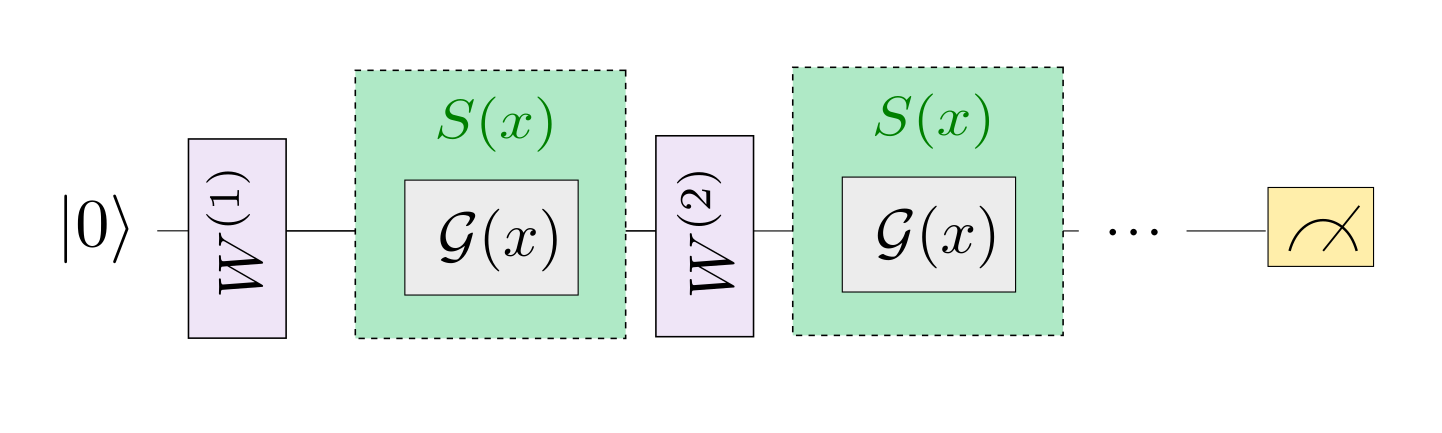
Make input data, define parallel quantum models, and do not perform model training results.
"""
Quantum Fourier Series
"""
import numpy as np
import pyqpanda as pq
from pyvqnet.qnn.measure import expval
import matplotlib.pyplot as plt
import matplotlib
try:
    matplotlib.use("TkAgg")
except:  # pylint:disable=bare-except
    print("Can not use matplot TkAgg")
    pass

np.random.seed(42)


degree = 1  # degree of the target function
scaling = 1  # scaling of the data
coeffs = [0.15 + 0.15j]*degree  # coefficients of non-zero frequencies
coeff0 = 0.1  # coefficient of zero frequency

def target_function(x):
    """Generate a truncated Fourier series, where the data gets re-scaled."""
    res = coeff0
    for idx, coeff in enumerate(coeffs):
        exponent = np.complex128(scaling * (idx+1) * x * 1j)
        conj_coeff = np.conjugate(coeff)
        res += coeff * np.exp(exponent) + conj_coeff * np.exp(-exponent)
    return np.real(res)

x = np.linspace(-6, 6, 70)
target_y = np.array([target_function(x_) for x_ in x])

plt.plot(x, target_y, c='black')
plt.scatter(x, target_y, facecolor='white', edgecolor='black')
plt.ylim(-1, 1)
plt.show()


def S(scaling, x, qubits):
    cir = pq.QCircuit()
    cir.insert(pq.RX(qubits[0], scaling * x))
    return cir

def W(theta, qubits):
    cir = pq.QCircuit()
    cir.insert(pq.RZ(qubits[0], theta[0]))
    cir.insert(pq.RY(qubits[0], theta[1]))
    cir.insert(pq.RZ(qubits[0], theta[2]))
    return cir

def serial_quantum_model(weights, x, num_qubits, scaling):
    cir = pq.QCircuit()
    machine = pq.CPUQVM()  # outside
    machine.init_qvm()  # outside
    qubits = machine.qAlloc_many(num_qubits)

    for theta in weights[:-1]:
        cir.insert(W(theta, qubits))
        cir.insert(S(scaling, x, qubits))

    # (L+1)'th unitary
    cir.insert(W(weights[-1], qubits))
    prog = pq.QProg()
    prog.insert(cir)

    exp_vals = []
    for position in range(num_qubits):
        pauli_str = {"Z" + str(position): 1.0}
        exp2 = expval(machine, prog, pauli_str, qubits)
        exp_vals.append(exp2)

    return exp_vals

r = 1
weights = 2 * np.pi * np.random.random(size=(r+1, 3))  # some random initial weights

x = np.linspace(-6, 6, 70)
random_quantum_model_y = [serial_quantum_model(weights, x_, 1, 1) for x_ in x]

plt.plot(x, target_y, c='black', label="true")
plt.scatter(x, target_y, facecolor='white', edgecolor='black')
plt.plot(x, random_quantum_model_y, c='blue', label="predict")
plt.ylim(-1, 1)
plt.legend(loc="upper right")
plt.show()
The result of running the quantum circuit without training is:
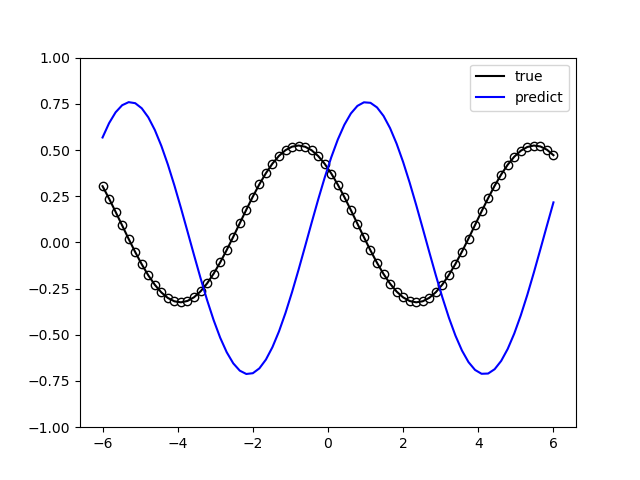
Make the input data, define the serial quantum model, and build the training model in combination with the QuantumLayer of the VQNet framework.
"""
Quantum Fourier Series Serial
"""
import numpy as np
from pyvqnet.nn.module import Module
from pyvqnet.nn.loss import MeanSquaredError
from pyvqnet.optim.adam import Adam
from pyvqnet.tensor.tensor import QTensor
import pyqpanda as pq
from pyvqnet.qnn.measure import expval
from pyvqnet.qnn.quantumlayer import QuantumLayer
import matplotlib.pyplot as plt
import matplotlib
try:
    matplotlib.use("TkAgg")
except:  # pylint:disable=bare-except
    print("Can not use matplot TkAgg")
    pass

np.random.seed(42)

degree = 1  # degree of the target function
scaling = 1  # scaling of the data
coeffs = [0.15 + 0.15j]*degree  # coefficients of non-zero frequencies
coeff0 = 0.1  # coefficient of zero frequency

def target_function(x):
    """Generate a truncated Fourier series, where the data gets re-scaled."""
    res = coeff0
    for idx, coeff in enumerate(coeffs):
        exponent = np.complex128(scaling * (idx+1) * x * 1j)
        conj_coeff = np.conjugate(coeff)
        res += coeff * np.exp(exponent) + conj_coeff * np.exp(-exponent)
    return np.real(res)

x = np.linspace(-6, 6, 70)
target_y = np.array([target_function(xx) for xx in x])

plt.plot(x, target_y, c='black')
plt.scatter(x, target_y, facecolor='white', edgecolor='black')
plt.ylim(-1, 1)
plt.show()


def S(x, qubits):
    cir = pq.QCircuit()
    cir.insert(pq.RX(qubits[0], x))
    return cir

def W(theta, qubits):
    cir = pq.QCircuit()
    cir.insert(pq.RZ(qubits[0], theta[0]))
    cir.insert(pq.RY(qubits[0], theta[1]))
    cir.insert(pq.RZ(qubits[0], theta[2]))
    return cir


r = 1
weights = 2 * np.pi * np.random.random(size=(r+1, 3))  # some random initial weights

x = np.linspace(-6, 6, 70)


def q_circuits_loop(x, weights, qubits, clist, machine):

    result = []
    for xx in x:
        cir = pq.QCircuit()
        weights = weights.reshape([2, 3])

        for theta in weights[:-1]:
            cir.insert(W(theta, qubits))
            cir.insert(S(xx, qubits))

        cir.insert(W(weights[-1], qubits))
        prog = pq.QProg()
        prog.insert(cir)

        exp_vals = []
        for position in range(1):
            pauli_str = {"Z" + str(position): 1.0}
            exp2 = expval(machine, prog, pauli_str, qubits)
            exp_vals.append(exp2)
            result.append(exp2)
    return result

class Model(Module):
    def __init__(self):
        super(Model, self).__init__()
        self.q_fourier_series = QuantumLayer(q_circuits_loop, 6, "CPU", 1)

    def forward(self, x):
        return self.q_fourier_series(x)

def run():
    model = Model()

    optimizer = Adam(model.parameters(), lr=0.5)
    batch_size = 2
    epoch = 5
    loss = MeanSquaredError()
    print("start training..............")
    model.train()
    max_steps = 50
    for i in range(epoch):
        sum_loss = 0
        count = 0
        for step in range(max_steps):
            optimizer.zero_grad()
            # Select batch of data
            batch_index = np.random.randint(0, len(x), (batch_size,))
            x_batch = x[batch_index]
            y_batch = target_y[batch_index]
            data, label = QTensor([x_batch]), QTensor([y_batch])
            result = model(data)
            loss_b = loss(label, result)
            loss_b.backward()
            optimizer._step()
            sum_loss += loss_b.item()
            count += batch_size
        print(f"epoch:{i}, #### loss:{sum_loss/count} ")

        model.eval()
        predictions = []
        for xx in x:
            data = QTensor([[xx]])
            result = model(data)
            predictions.append(result.pdata[0])

        plt.plot(x, target_y, c='black', label="true")
        plt.scatter(x, target_y, facecolor='white', edgecolor='black')
        plt.plot(x, predictions, c='blue', label="predict")
        plt.ylim(-1, 1)
        plt.legend(loc="upper right")
        plt.show()

if __name__ == "__main__":
    run()
The quantum model is:

The network training results are:
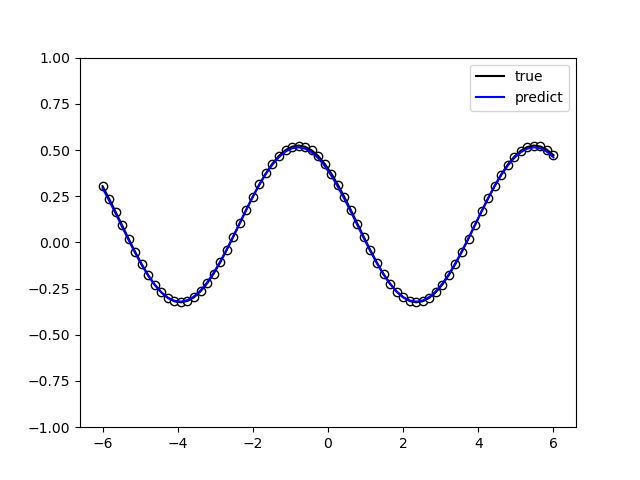
The network training loss is:
start training..............
epoch:0, #### loss:0.04852807720773853
epoch:1, #### loss:0.012945819365559146
epoch:2, #### loss:0.0009359727291666786
epoch:3, #### loss:0.00015995280153333625
epoch:4, #### loss:3.988249877352246e-05
1.2Fitting Fourier series with parallel Pauli-rotation encoding
As shown in the paper, we expect similar results to the serial model: a Fourier series of order r can only be fitted if the encoded gate has at least r repetitions in the quantum model. Quantum circuit:
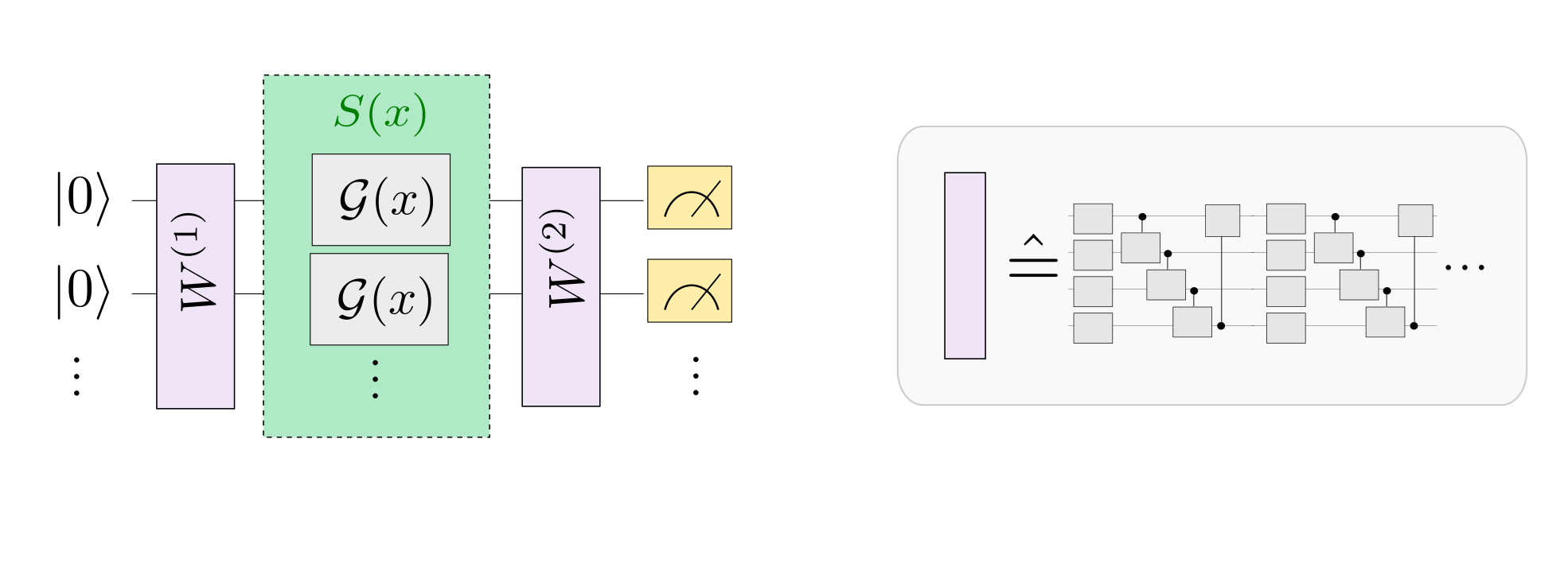
Make input data, define parallel quantum models, and do not perform model training results.
"""
Quantum Fourier Series
"""
import numpy as np
import pyqpanda as pq
from pyvqnet.qnn.measure import expval
import matplotlib.pyplot as plt
import matplotlib
try:
    matplotlib.use("TkAgg")
except:  # pylint:disable=bare-except
    print("Can not use matplot TkAgg")
    pass

np.random.seed(42)

degree = 1  # degree of the target function
scaling = 1  # scaling of the data
coeffs = [0.15 + 0.15j] * degree  # coefficients of non-zero frequencies
coeff0 = 0.1  # coefficient of zero frequency

def target_function(x):
    """Generate a truncated Fourier series, where the data gets re-scaled."""
    res = coeff0
    for idx, coeff in enumerate(coeffs):
        exponent = np.complex128(scaling * (idx + 1) * x * 1j)
        conj_coeff = np.conjugate(coeff)
        res += coeff * np.exp(exponent) + conj_coeff * np.exp(-exponent)
    return np.real(res)

x = np.linspace(-6, 6, 70)
target_y = np.array([target_function(xx) for xx in x])


def S1(x, qubits):
    cir = pq.QCircuit()
    for q in qubits:
        cir.insert(pq.RX(q, x))
    return cir

def W1(theta, qubits):
    cir = pq.QCircuit()
    for i in range(len(qubits)):
        cir.insert(pq.RZ(qubits[i], theta[0][i][0]))
        cir.insert(pq.RY(qubits[i], theta[0][i][1]))
        cir.insert(pq.RZ(qubits[i], theta[0][i][2]))

    for i in range(len(qubits) - 1):
        cir.insert(pq.CNOT(qubits[i], qubits[i + 1]))
    cir.insert(pq.CNOT(qubits[len(qubits) - 1], qubits[0]))

    for i in range(len(qubits)):
        cir.insert(pq.RZ(qubits[i], theta[1][i][0]))
        cir.insert(pq.RY(qubits[i], theta[1][i][1]))
        cir.insert(pq.RZ(qubits[i], theta[1][i][2]))

    cir.insert(pq.CNOT(qubits[0], qubits[len(qubits) - 1]))
    for i in range(len(qubits) - 1):
        cir.insert(pq.CNOT(qubits[i + 1], qubits[i]))

    for i in range(len(qubits)):
        cir.insert(pq.RZ(qubits[i], theta[2][i][0]))
        cir.insert(pq.RY(qubits[i], theta[2][i][1]))
        cir.insert(pq.RZ(qubits[i], theta[2][i][2]))

    for i in range(len(qubits) - 1):
        cir.insert(pq.CNOT(qubits[i], qubits[i + 1]))
    cir.insert(pq.CNOT(qubits[len(qubits) - 1], qubits[0]))

    return cir

def parallel_quantum_model(weights, x, num_qubits):
    cir = pq.QCircuit()
    machine = pq.CPUQVM()  # outside
    machine.init_qvm()  # outside
    qubits = machine.qAlloc_many(num_qubits)

    cir.insert(W1(weights[0], qubits))
    cir.insert(S1(x, qubits))

    cir.insert(W1(weights[1], qubits))
    prog = pq.QProg()
    prog.insert(cir)

    exp_vals = []
    for position in range(1):
        pauli_str = {"Z" + str(position): 1.0}
        exp2 = expval(machine, prog, pauli_str, qubits)
        exp_vals.append(exp2)

    return exp_vals

r = 3

trainable_block_layers = 3
weights = 2 * np.pi * np.random.random(size=(2, trainable_block_layers, r, 3))
# print(weights)
x = np.linspace(-6, 6, 70)
random_quantum_model_y = [parallel_quantum_model(weights, xx, r) for xx in x]

plt.plot(x, target_y, c='black', label="true")
plt.scatter(x, target_y, facecolor='white', edgecolor='black')
plt.plot(x, random_quantum_model_y, c='blue', label="predict")
plt.ylim(-1, 1)
plt.legend(loc="upper right")
plt.show()
The result of running the quantum circuit without training is:
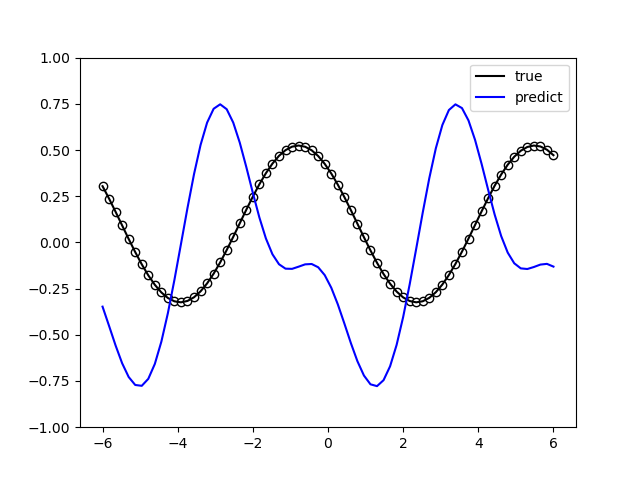
Make the input data, define the parallel quantum model, and build the training model in combination with the QuantumLayer layer of the VQNet framework.
"""
Quantum Fourier Series
"""
import numpy as np

from pyvqnet.nn.module import Module
from pyvqnet.nn.loss import MeanSquaredError
from pyvqnet.optim.adam import Adam
from pyvqnet.tensor.tensor import QTensor
import pyqpanda as pq
from pyvqnet.qnn.measure import expval
from pyvqnet.qnn.quantumlayer import QuantumLayer, QuantumLayerMultiProcess
import matplotlib.pyplot as plt
import matplotlib
try:
    matplotlib.use("TkAgg")
except:  # pylint:disable=bare-except
    print("Can not use matplot TkAgg")
    pass

np.random.seed(42)

degree = 1  # degree of the target function
scaling = 1  # scaling of the data
coeffs = [0.15 + 0.15j] * degree  # coefficients of non-zero frequencies
coeff0 = 0.1  # coefficient of zero frequency

def target_function(x):
    """Generate a truncated Fourier series, where the data gets re-scaled."""
    res = coeff0
    for idx, coeff in enumerate(coeffs):
        exponent = np.complex128(scaling * (idx + 1) * x * 1j)
        conj_coeff = np.conjugate(coeff)
        res += coeff * np.exp(exponent) + conj_coeff * np.exp(-exponent)
    return np.real(res)

x = np.linspace(-6, 6, 70)
target_y = np.array([target_function(xx) for xx in x])

plt.plot(x, target_y, c='black')
plt.scatter(x, target_y, facecolor='white', edgecolor='black')
plt.ylim(-1, 1)
plt.show()

def S1(x, qubits):
    cir = pq.QCircuit()
    for q in qubits:
        cir.insert(pq.RX(q, x))
    return cir

def W1(theta, qubits):
    cir = pq.QCircuit()
    for i in range(len(qubits)):
        cir.insert(pq.RZ(qubits[i], theta[0][i][0]))
        cir.insert(pq.RY(qubits[i], theta[0][i][1]))
        cir.insert(pq.RZ(qubits[i], theta[0][i][2]))

    for i in range(len(qubits) - 1):
        cir.insert(pq.CNOT(qubits[i], qubits[i + 1]))
    cir.insert(pq.CNOT(qubits[len(qubits) - 1], qubits[0]))

    for i in range(len(qubits)):
        cir.insert(pq.RZ(qubits[i], theta[1][i][0]))
        cir.insert(pq.RY(qubits[i], theta[1][i][1]))
        cir.insert(pq.RZ(qubits[i], theta[1][i][2]))

    cir.insert(pq.CNOT(qubits[0], qubits[len(qubits) - 1]))
    for i in range(len(qubits) - 1):
        cir.insert(pq.CNOT(qubits[i + 1], qubits[i]))

    for i in range(len(qubits)):
        cir.insert(pq.RZ(qubits[i], theta[2][i][0]))
        cir.insert(pq.RY(qubits[i], theta[2][i][1]))
        cir.insert(pq.RZ(qubits[i], theta[2][i][2]))

    for i in range(len(qubits) - 1):
        cir.insert(pq.CNOT(qubits[i], qubits[i + 1]))
    cir.insert(pq.CNOT(qubits[len(qubits) - 1], qubits[0]))

    return cir

def q_circuits_loop(x, weights, qubits, clist, machine):

    result = []
    for xx in x:
        cir = pq.QCircuit()
        weights = weights.reshape([2, 3, 3, 3])

        cir.insert(W1(weights[0], qubits))
        cir.insert(S1(xx, qubits))

        cir.insert(W1(weights[1], qubits))
        prog = pq.QProg()
        prog.insert(cir)

        exp_vals = []
        for position in range(1):
            pauli_str = {"Z" + str(position): 1.0}
            exp2 = expval(machine, prog, pauli_str, qubits)
            exp_vals.append(exp2)
            result.append(exp2)
    return result


class Model(Module):
    def __init__(self):
        super(Model, self).__init__()

        self.q_fourier_series = QuantumLayer(q_circuits_loop, 2 * 3 * 3 * 3, "CPU", 1)

    def forward(self, x):
        return self.q_fourier_series(x)

def run():
    model = Model()

    optimizer = Adam(model.parameters(), lr=0.01)
    batch_size = 2
    epoch = 5
    loss = MeanSquaredError()
    print("start training..............")
    model.train()
    max_steps = 50
    for i in range(epoch):
        sum_loss = 0
        count = 0
        for step in range(max_steps):
            optimizer.zero_grad()
            # Select batch of data
            batch_index = np.random.randint(0, len(x), (batch_size,))
            x_batch = x[batch_index]
            y_batch = target_y[batch_index]
            data, label = QTensor([x_batch]), QTensor([y_batch])
            result = model(data)
            loss_b = loss(label, result)
            loss_b.backward()
            optimizer._step()
            sum_loss += loss_b.item()
            count += batch_size

        loss_cout = sum_loss / count
        print(f"epoch:{i}, #### loss:{loss_cout} ")

        if loss_cout < 0.002:
            model.eval()
            predictions = []
            for xx in x:
                data = QTensor([[xx]])
                result = model(data)
                predictions.append(result.pdata[0])

            plt.plot(x, target_y, c='black', label="true")
            plt.scatter(x, target_y, facecolor='white', edgecolor='black')
            plt.plot(x, predictions, c='blue', label="predict")
            plt.ylim(-1, 1)
            plt.legend(loc="upper right")
            plt.show()


if __name__ == "__main__":
    run()
The quantum model is:
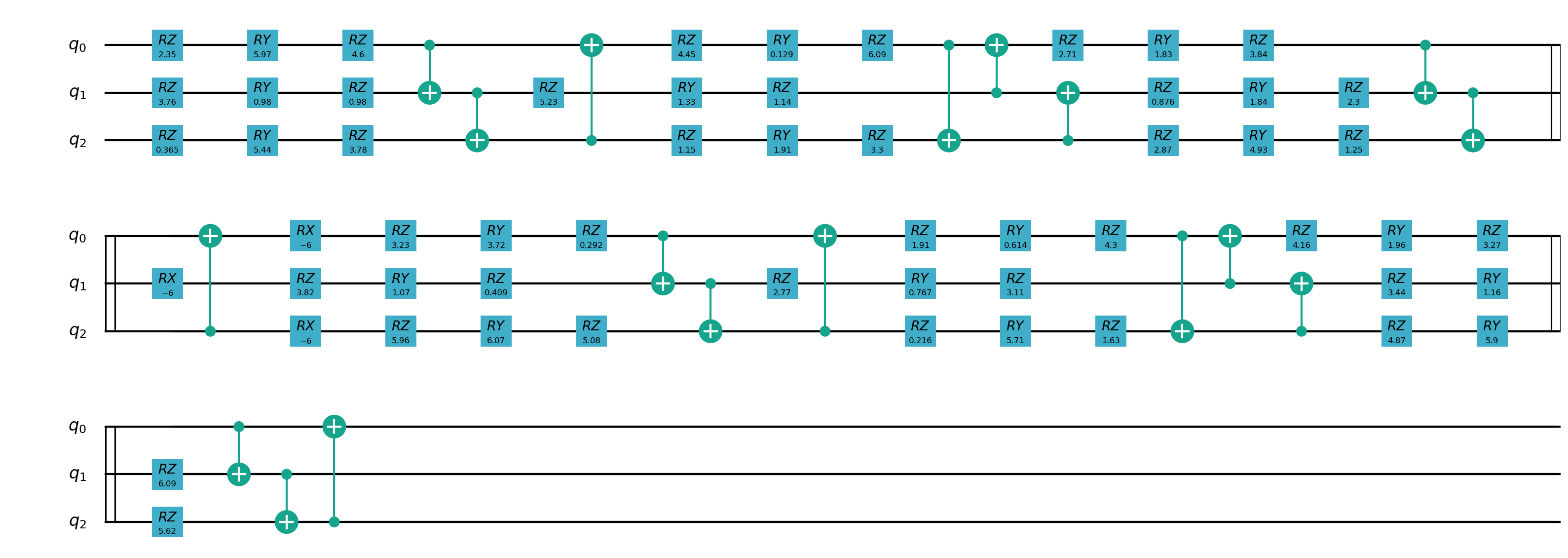
The network training results are:
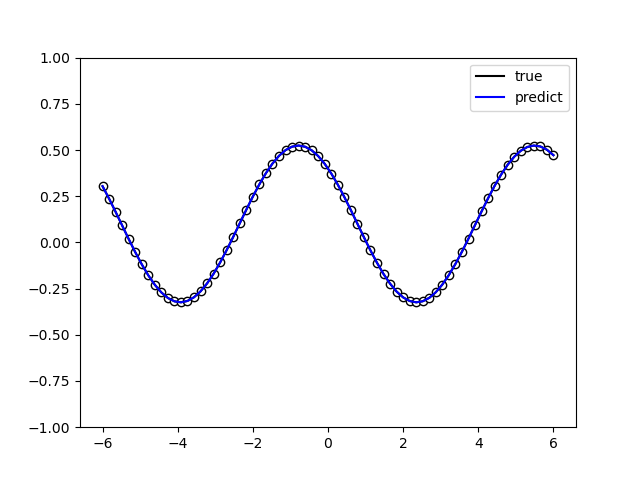
The network training loss is:
start training..............
epoch:0, #### loss:0.0037272341538482578
epoch:1, #### loss:5.271130586635309e-05
epoch:2, #### loss:4.714951917250687e-07
epoch:3, #### loss:1.0968826371082763e-08
epoch:4, #### loss:2.1258629738507562e-10